LunarCrush: The Product (2026)
LunarCrush · Head of Design · Jan 2021 to present · Ongoing
As Head of Design, I led the 2026 product redesign around a single decision: make AI the centre. A 700-pixel column, a prompt field on every page, a topic-based data model that covers every asset type, and an MCP-powered bridge out to any LLM.
Context
LunarCrush correlates what the world is saying online with what's moving in markets. I've led design end-to-end since January 2021: product, marketing, brand, research, design systems.
This case study walks through the 2026 product redesign, the app you land on after login at lunarcrush.com. The public marketing site is covered in a separate case study; a December 2025 experiment built on top of our data is in Trading Bot.
The shift: AI at the centre
We were reacting to a new reality: users don't want to browse dashboards anymore, they want to ask questions. LLMs had trained everyone to expect a prompt as the first-class interaction.
I led the team through recurring working sessions with engineering, data, and leadership to figure out how to re-anchor LunarCrush. The tension we kept returning to: our value isn't the charts, it's the underlying data, the millions of social conversations distilled into signal. The question wasn't "how do we add AI to the app" but "how do we make our data legible to an AI that's already in the user's hand?"
The answer was structural. I committed the product to a 700-pixel central column across every main view. That constraint forced a consistent reading rhythm and reserved the visual centre-of-gravity for a prompt field.
The prompt sits persistently on almost every page, with a HISTORY button next to it. Underneath, we wired it to our MCP server so any model (Claude, ChatGPT, Gemini, Grok, Perplexity, Cursor) can answer using LunarCrush data through a shared protocol. Rather than invent new visual primitives for answers, we reused the same components the app already renders. A conversation grows into a long, branching thread with native-looking responses at every turn.
The topic as the spine
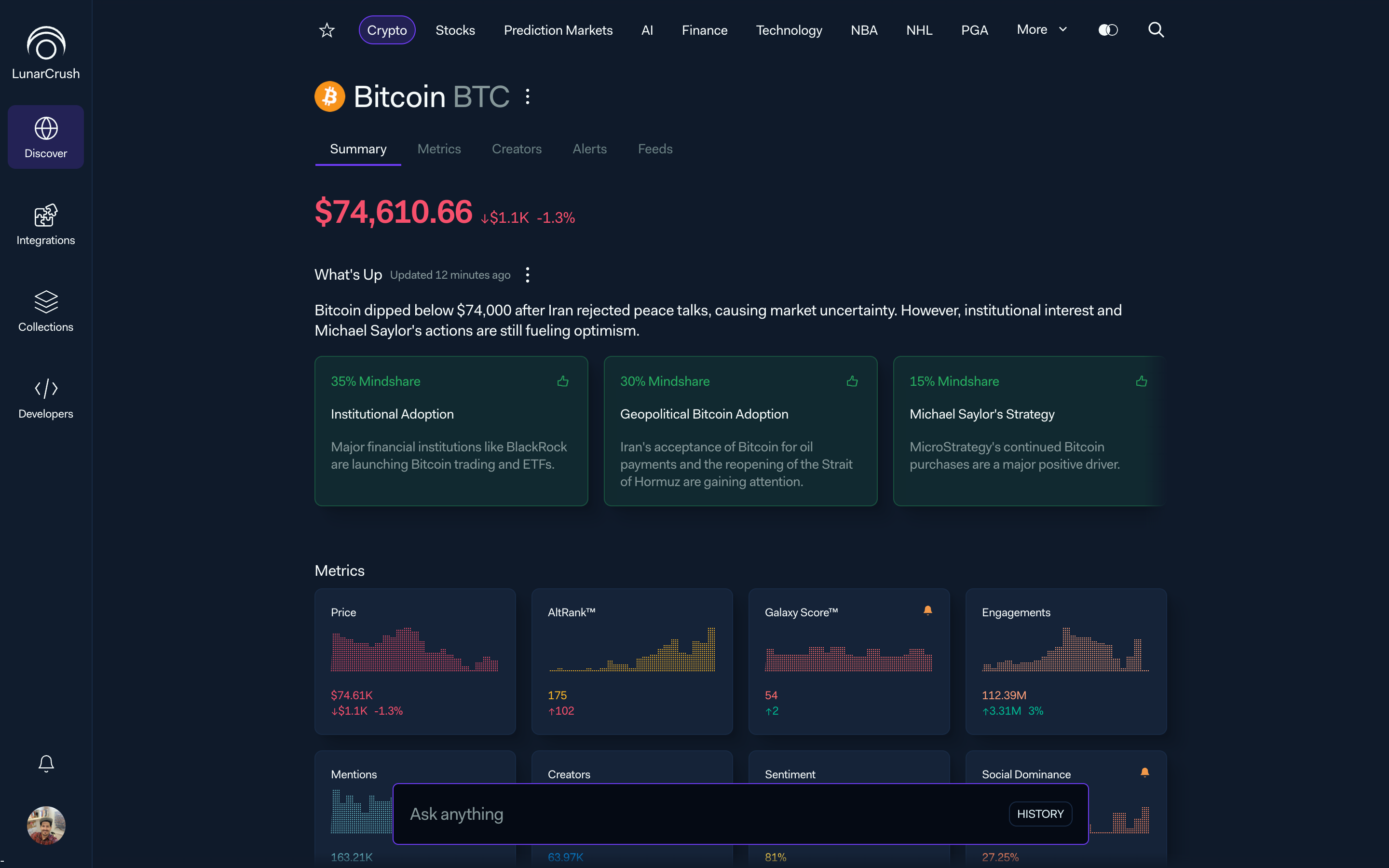
Every asset, brand, person, event, or subject in LunarCrush is a topic. Same shape, same API, same tabs.
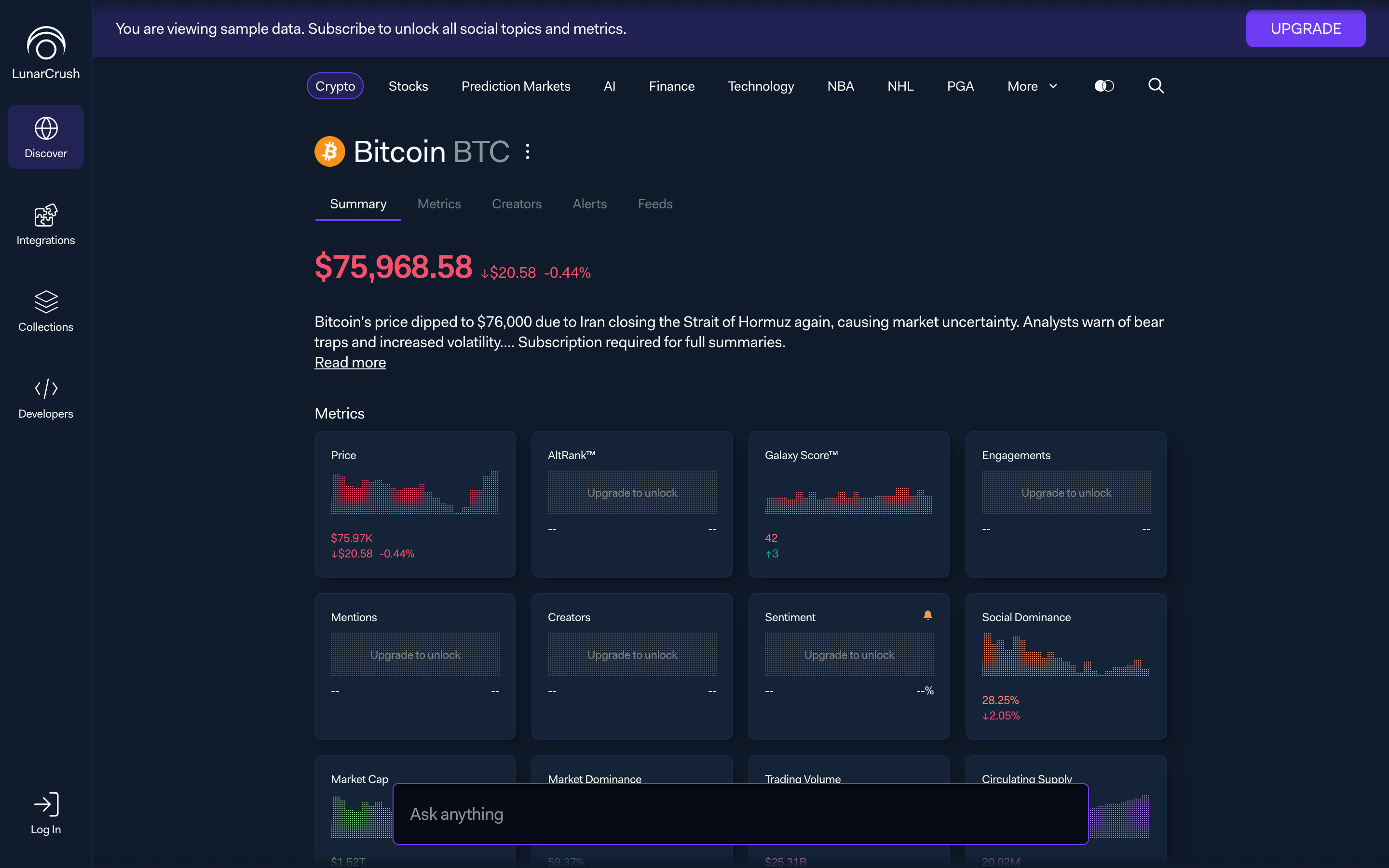
Summary leads with the auto-authored "What's Up" paragraph, mindshare-weighted narrative cards, and a leading-items table beneath.
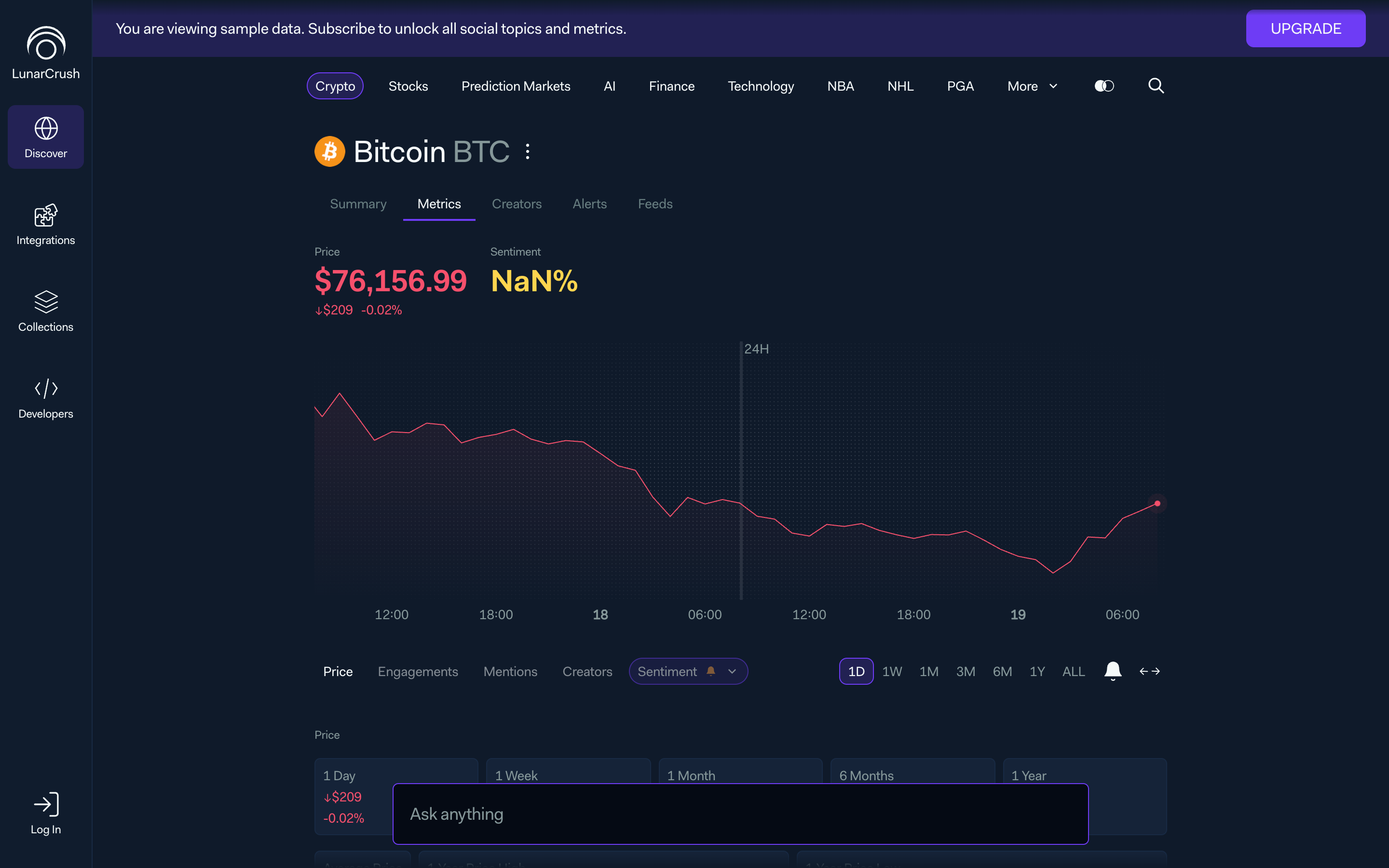
Metrics plots any LunarCrush dimension as a time-series: sentiment, Galaxy Score, AltRank, engagements, mentions, creators. Intervals go 1D through ALL.
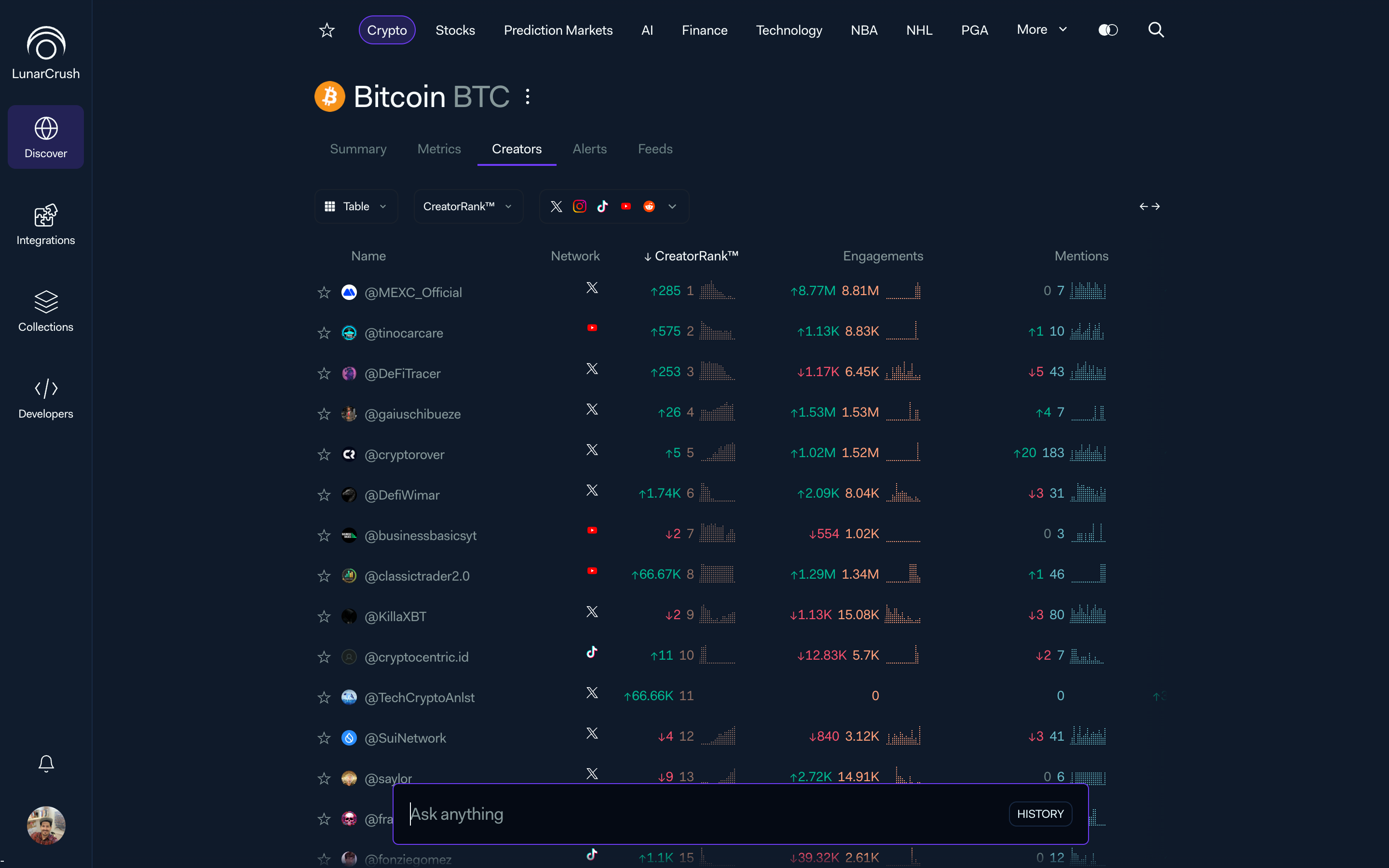
Creators ranks the voices driving the conversation about this topic across X, YouTube, TikTok, Reddit, and more.
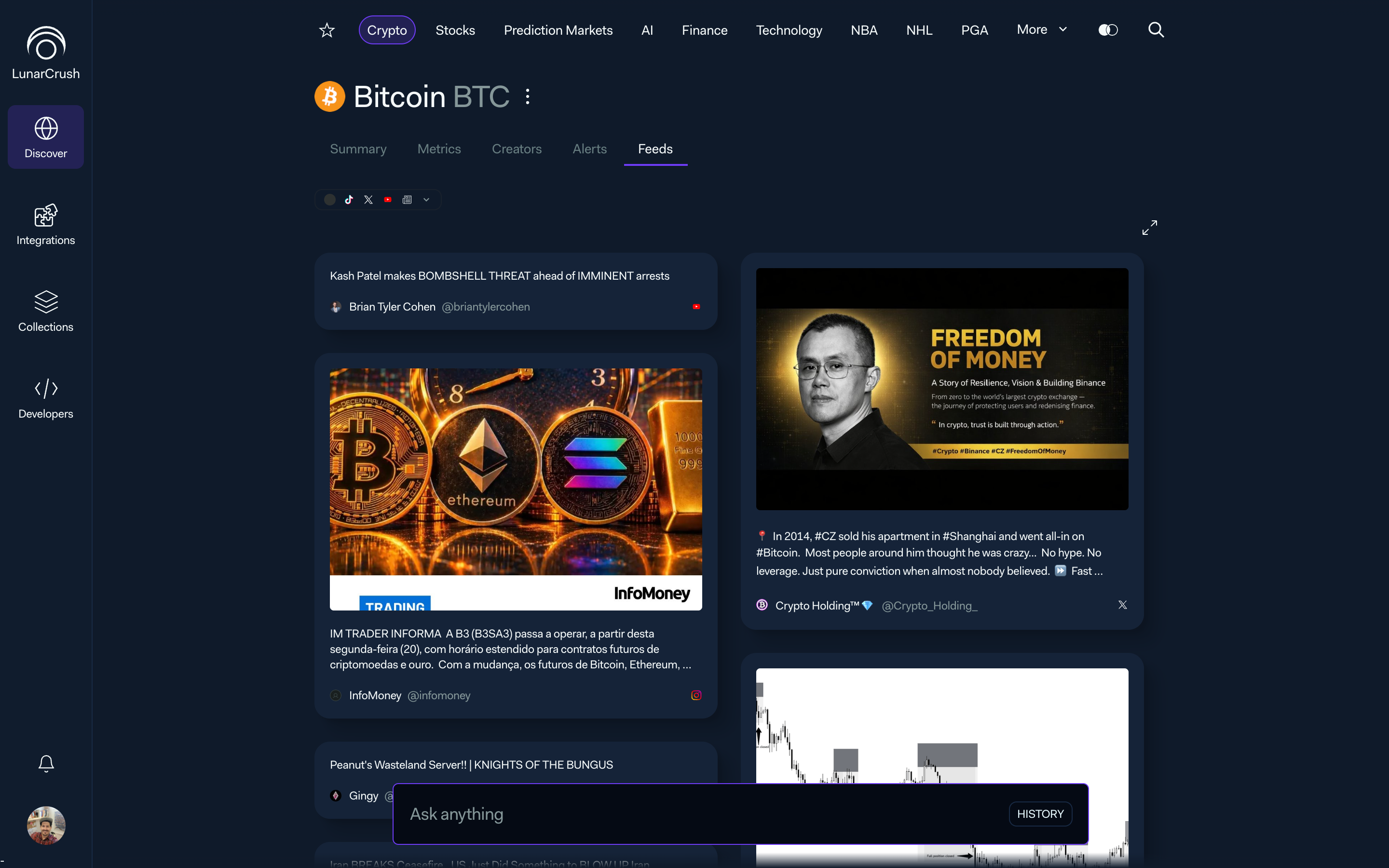
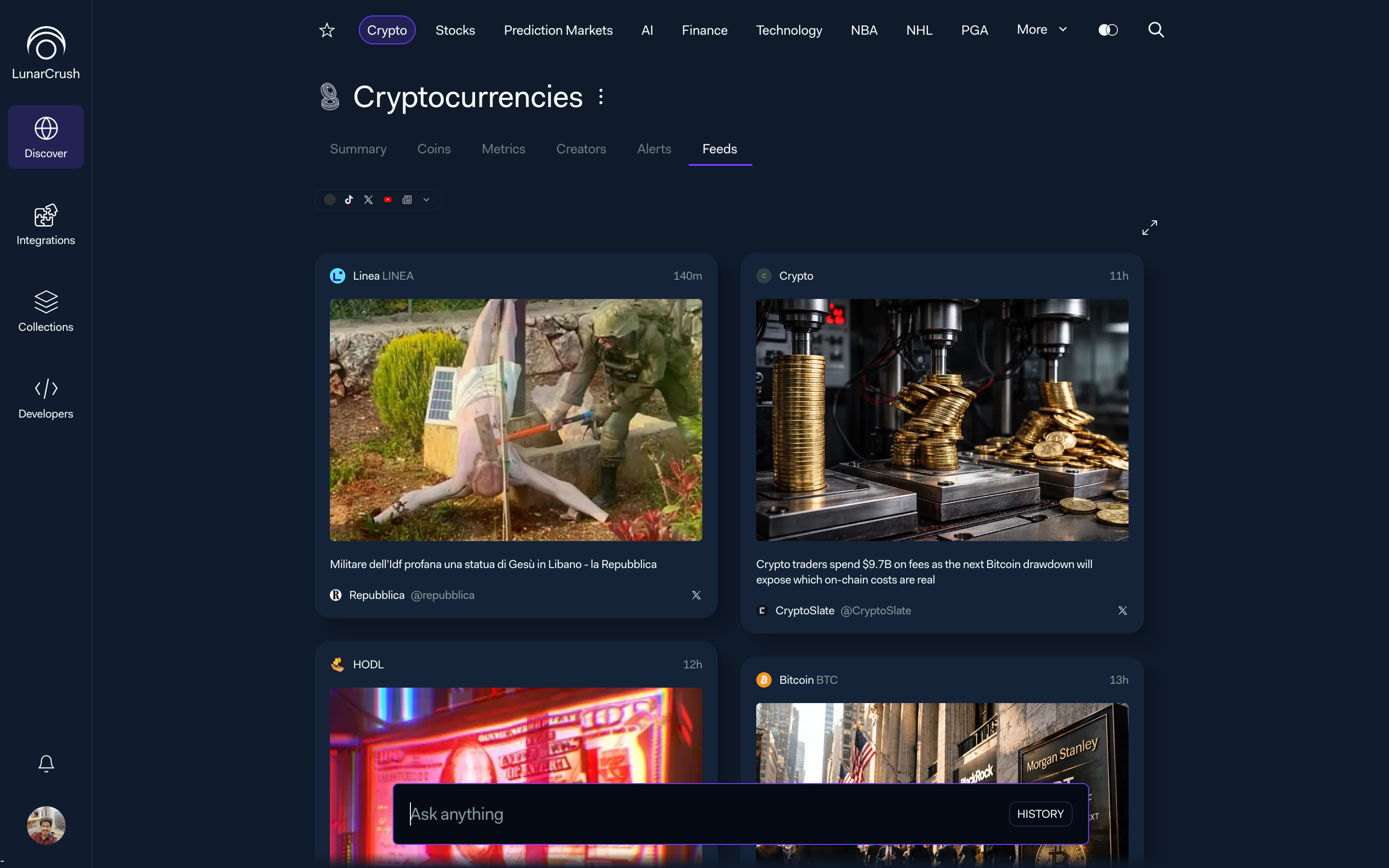
Feeds drops to the raw posts, the actual signal everything above aggregates from.
Alerts and News round out the tab set: configurable triggers and surfaced press.
The same tabs hold across very different topic types. A stock opens with a price header. A company swaps the header for an avatar. A politician, a sports team, a global event: all different heads, same spine.
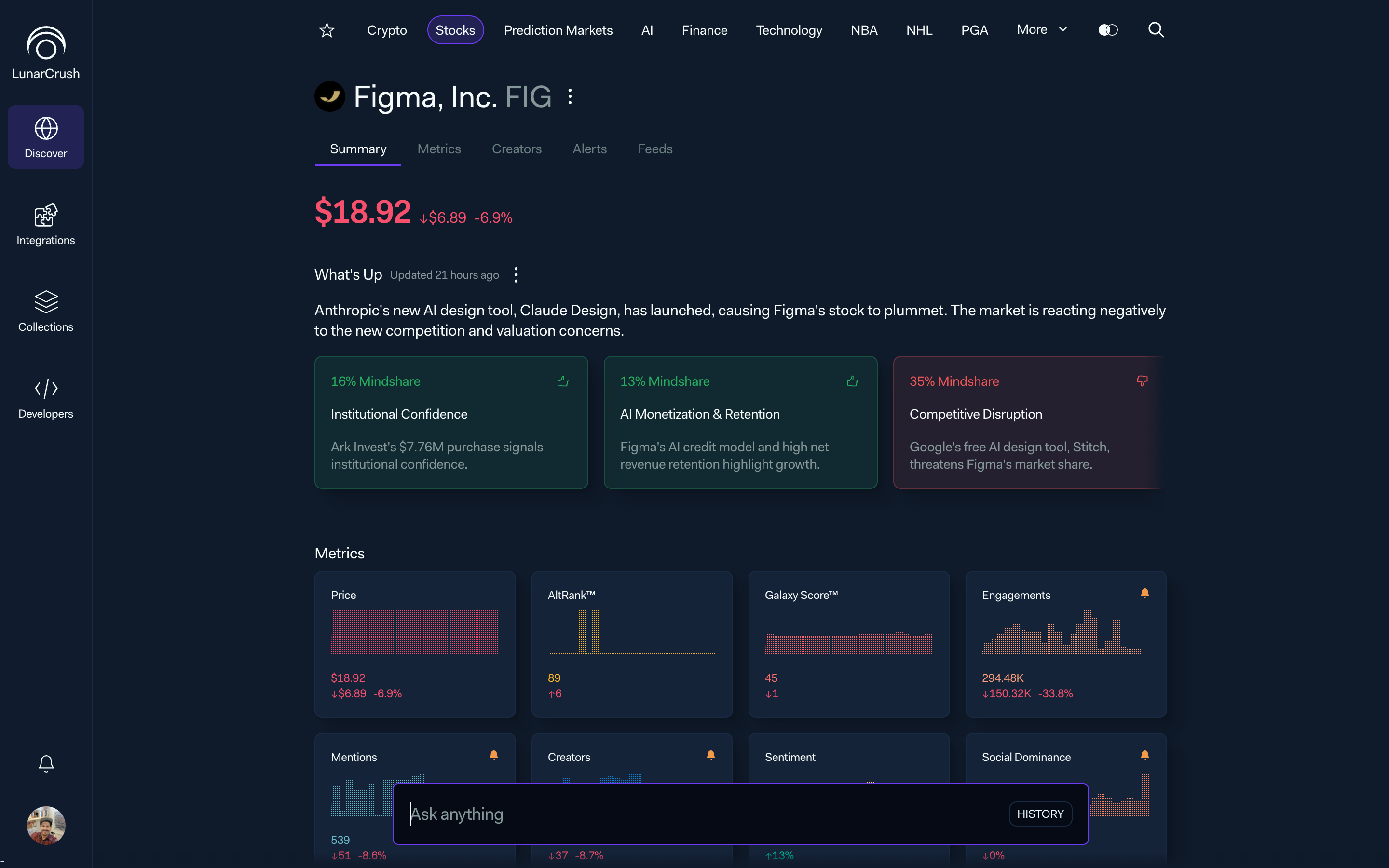
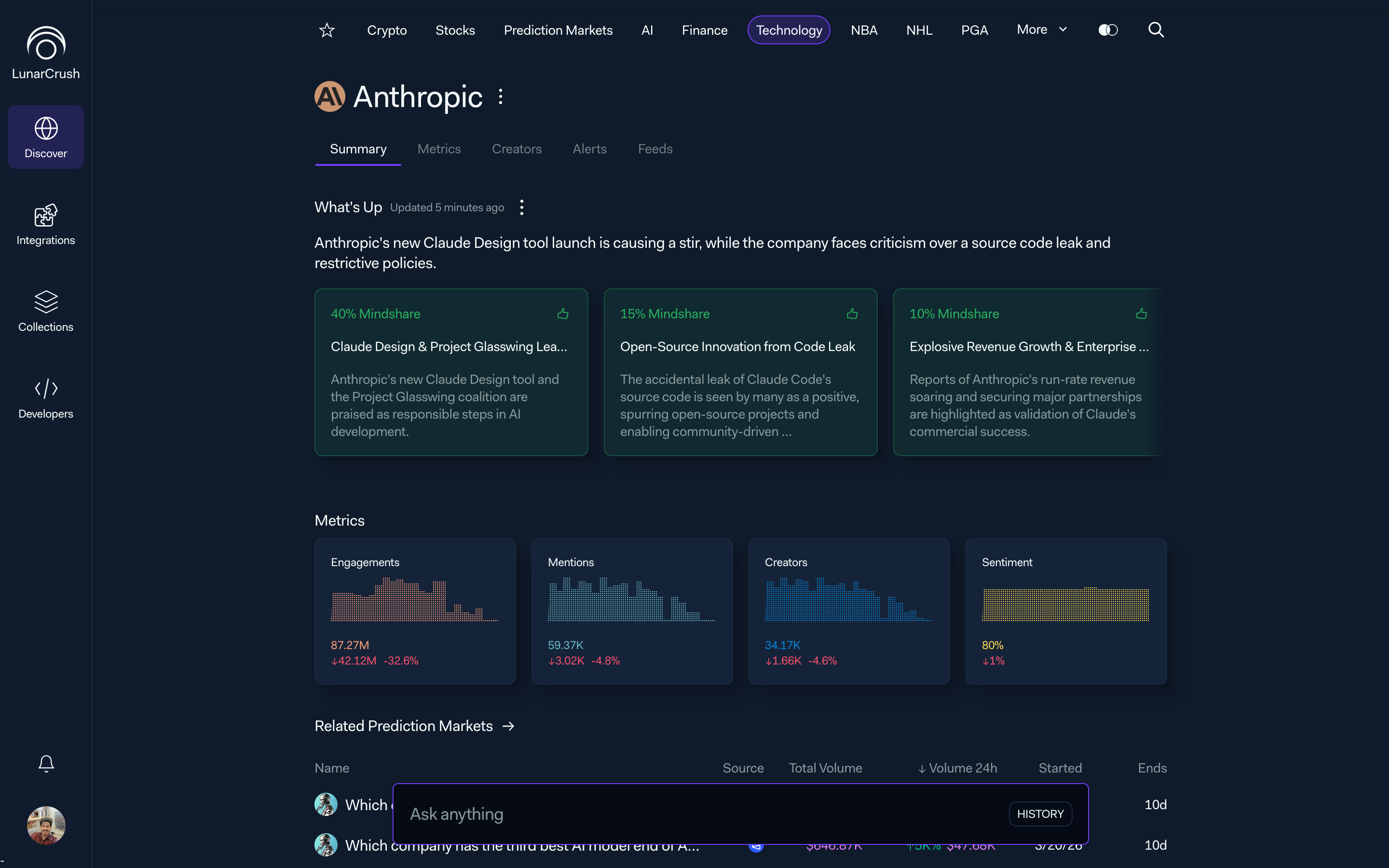
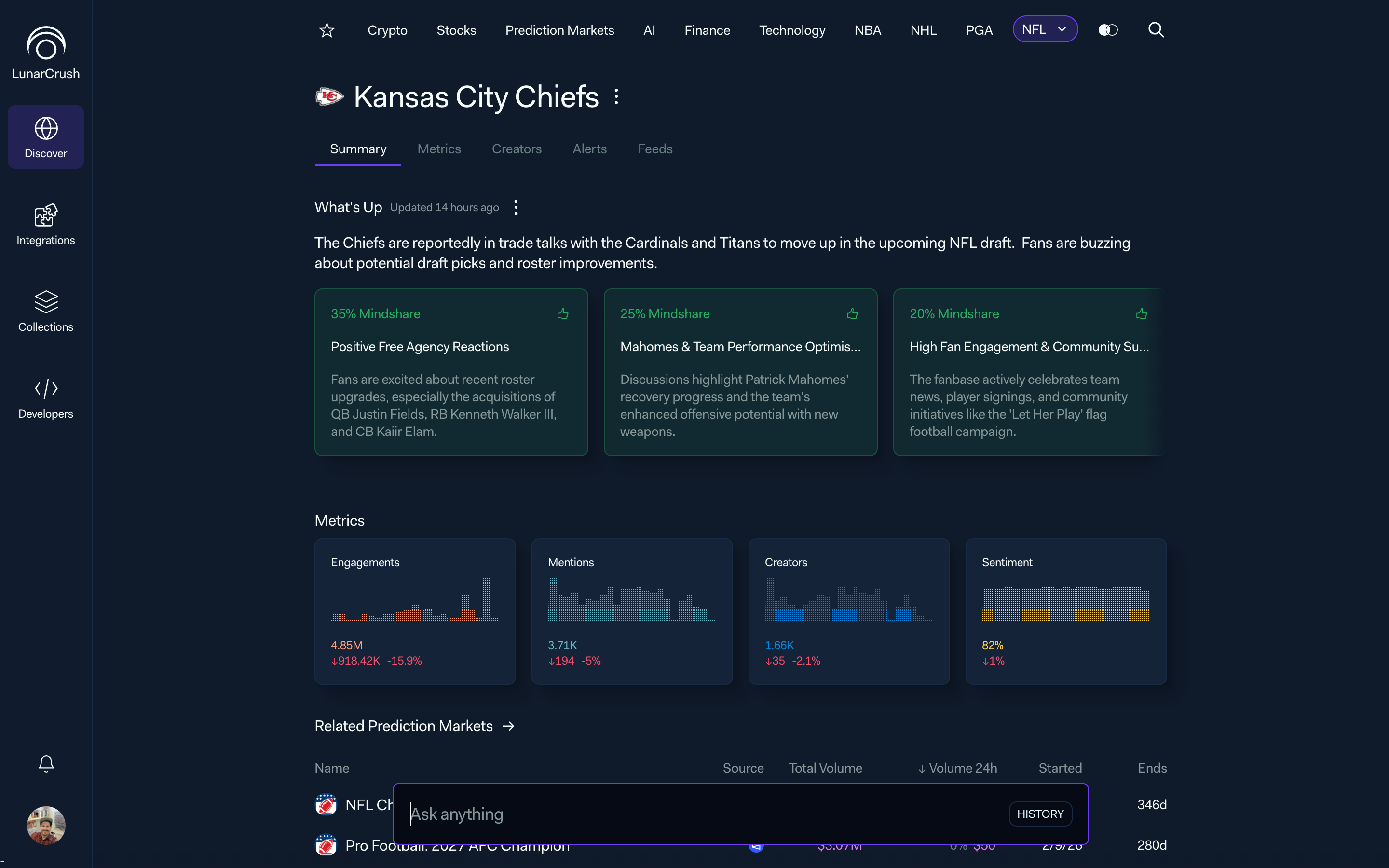
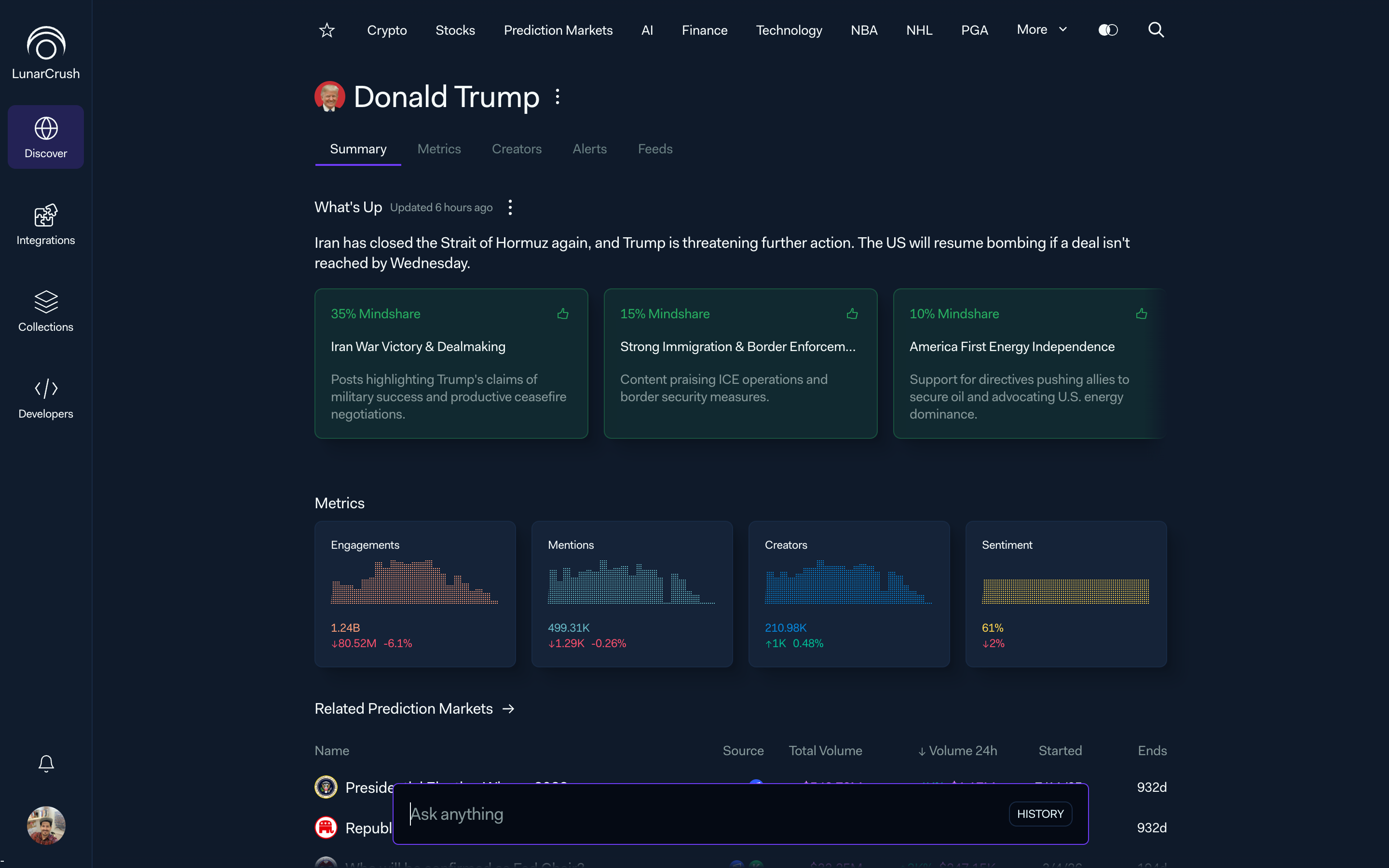
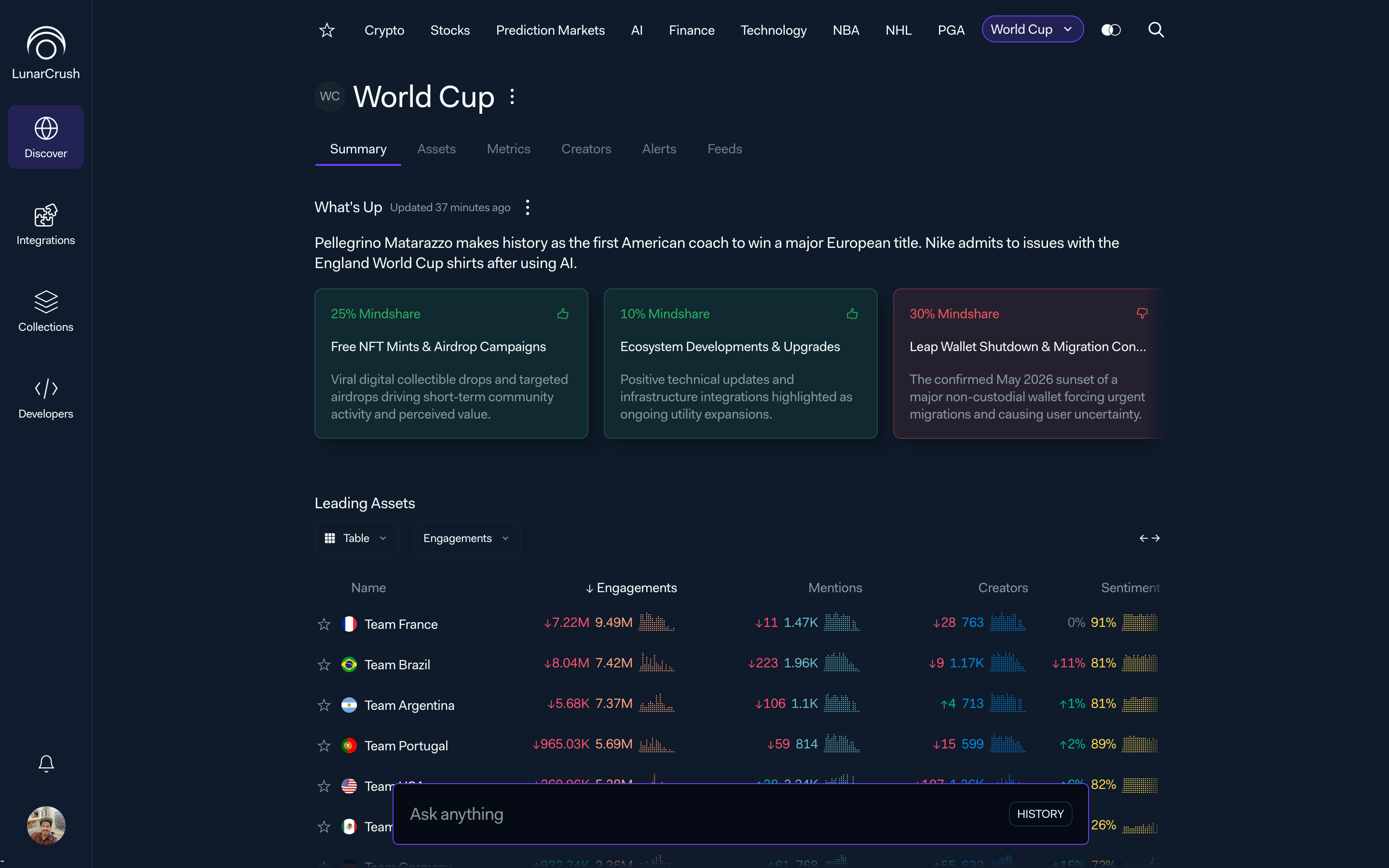
This is the load-bearing decision of the redesign: one shell, every asset type. The data pipeline, the AI, and the UI don't care whether it's a coin or a quarterback. They all speak topic.
Categories: topics that contain topics
A category is a topic whose children are also topics. Crypto, Stocks, Prediction Markets, AI, Finance, Technology, NFL, NBA, NHL, PGA, Countries, Celebrities, and more. Each uses the same tab structure, just one level up.
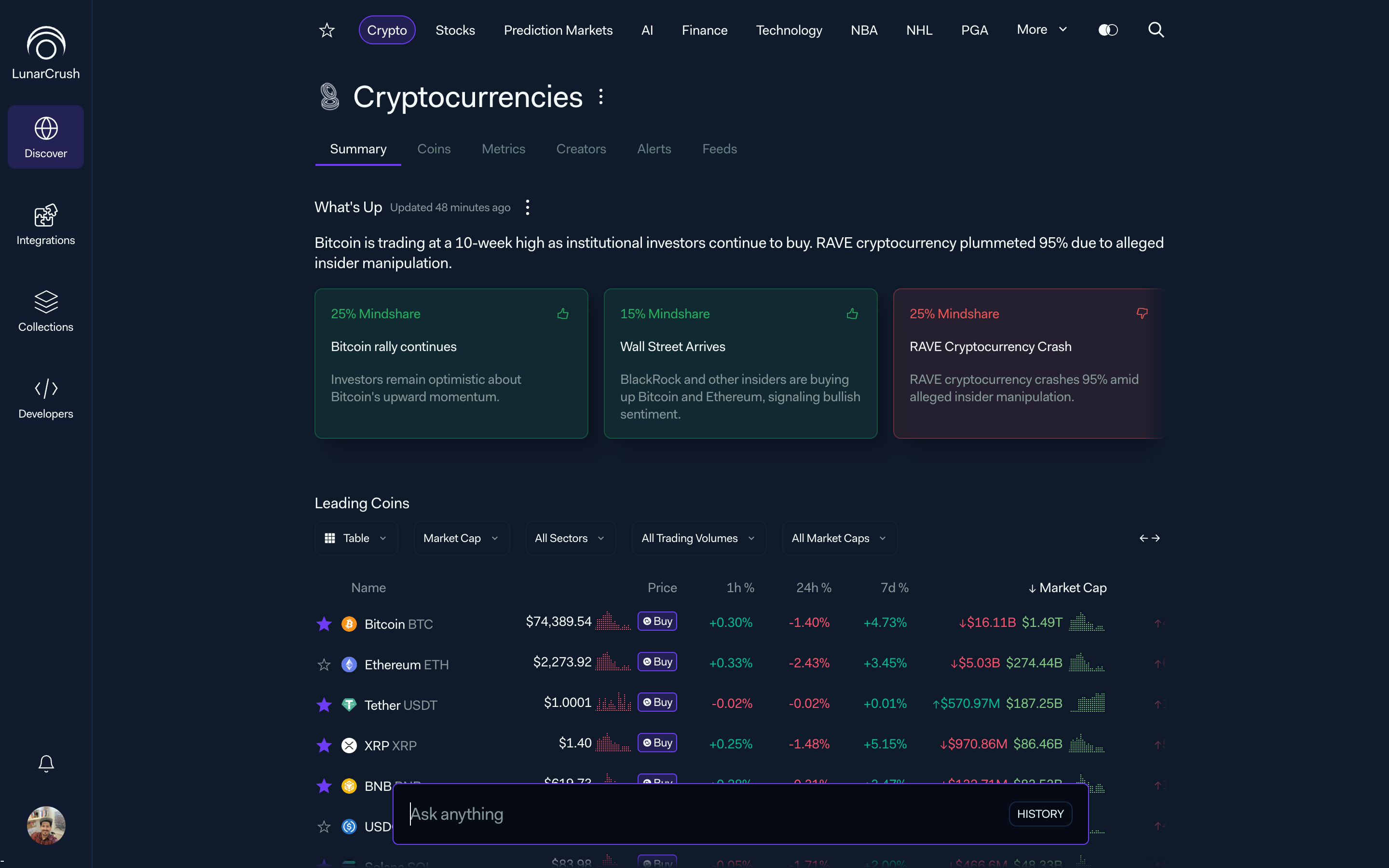
Summary picks the most-discussed stories in the category, ranked by mindshare, and surfaces a table of leading items.
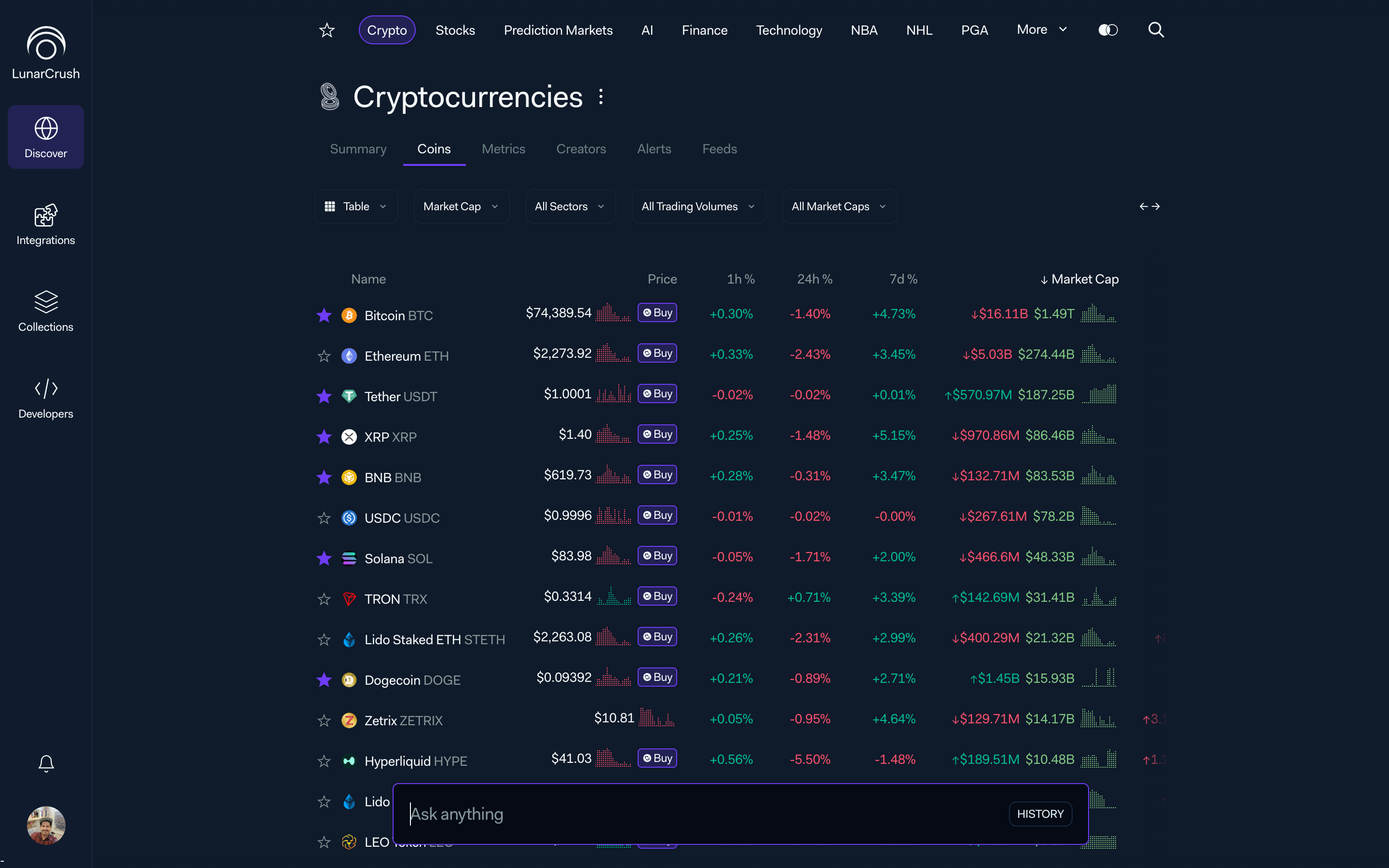
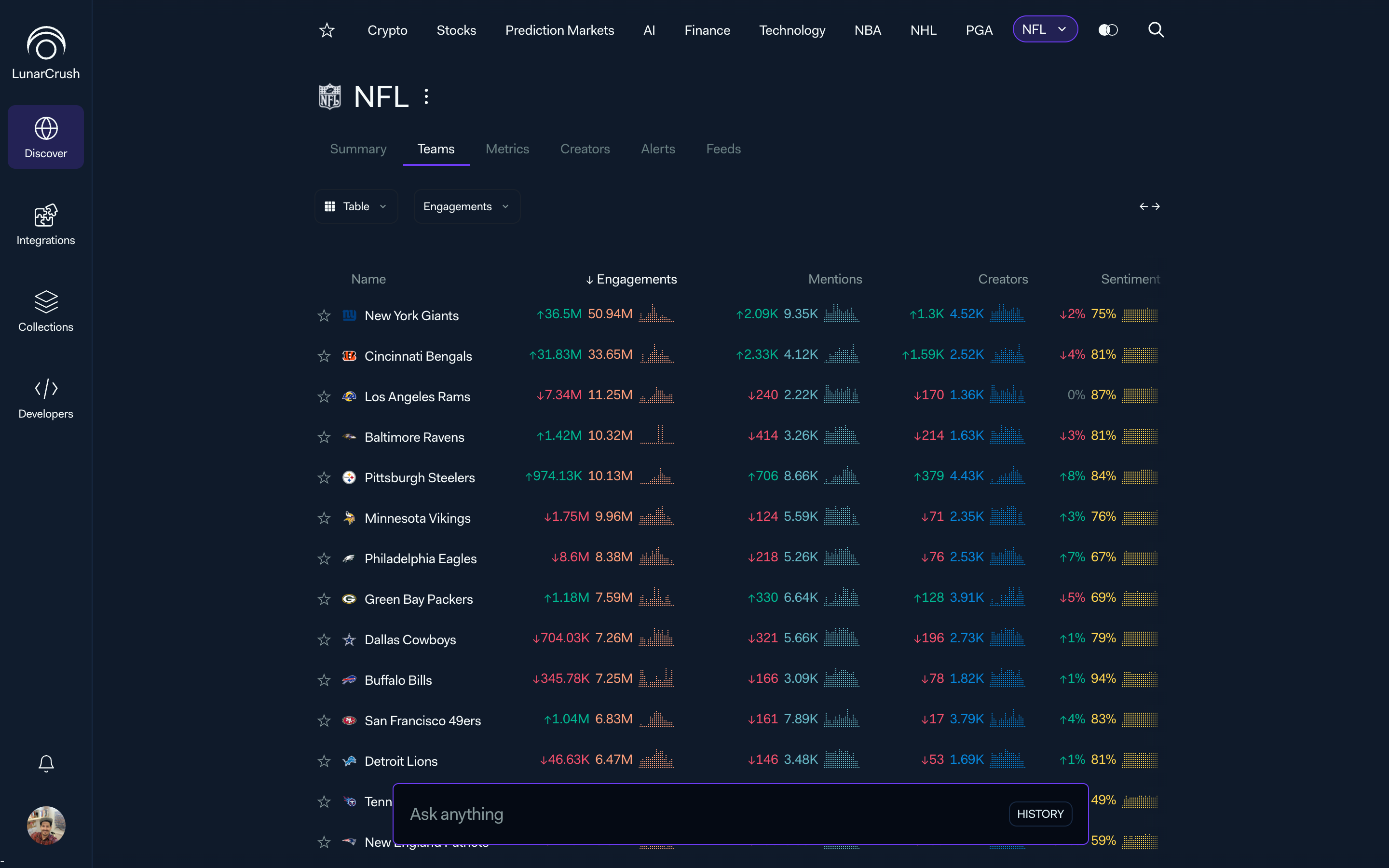
Coins / Teams / Assets is the list view, sortable by any LunarCrush metric. The name of the tab adapts to the vertical (Coins for crypto, Teams for NFL, Events for prediction markets); the table behaviour does not.
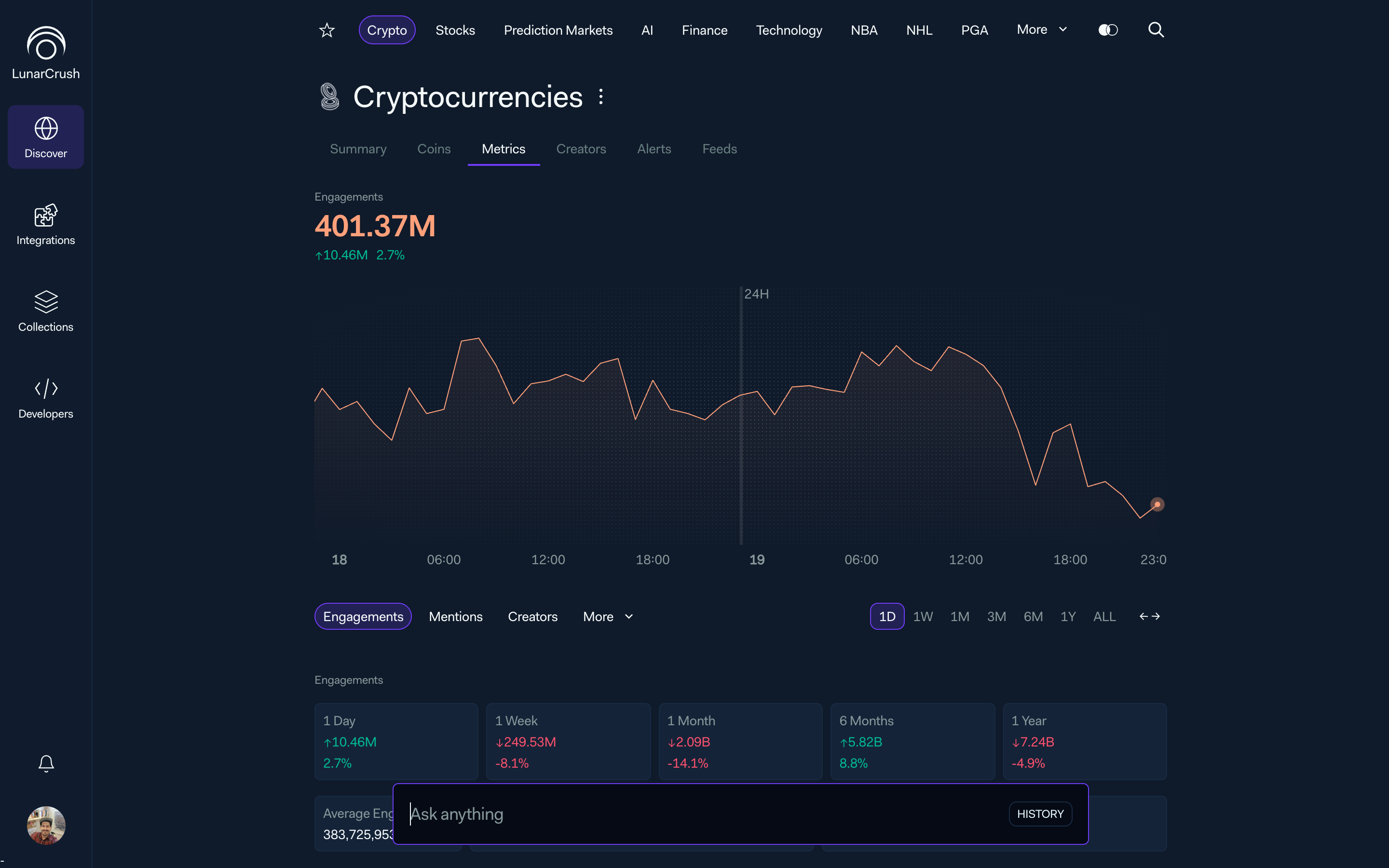
Metrics aggregates time-series at the category level. 401M engagements across all of crypto in a single glance; the same chart exists for any other category.
Creators ranks top voices inside the category, cross-platform.
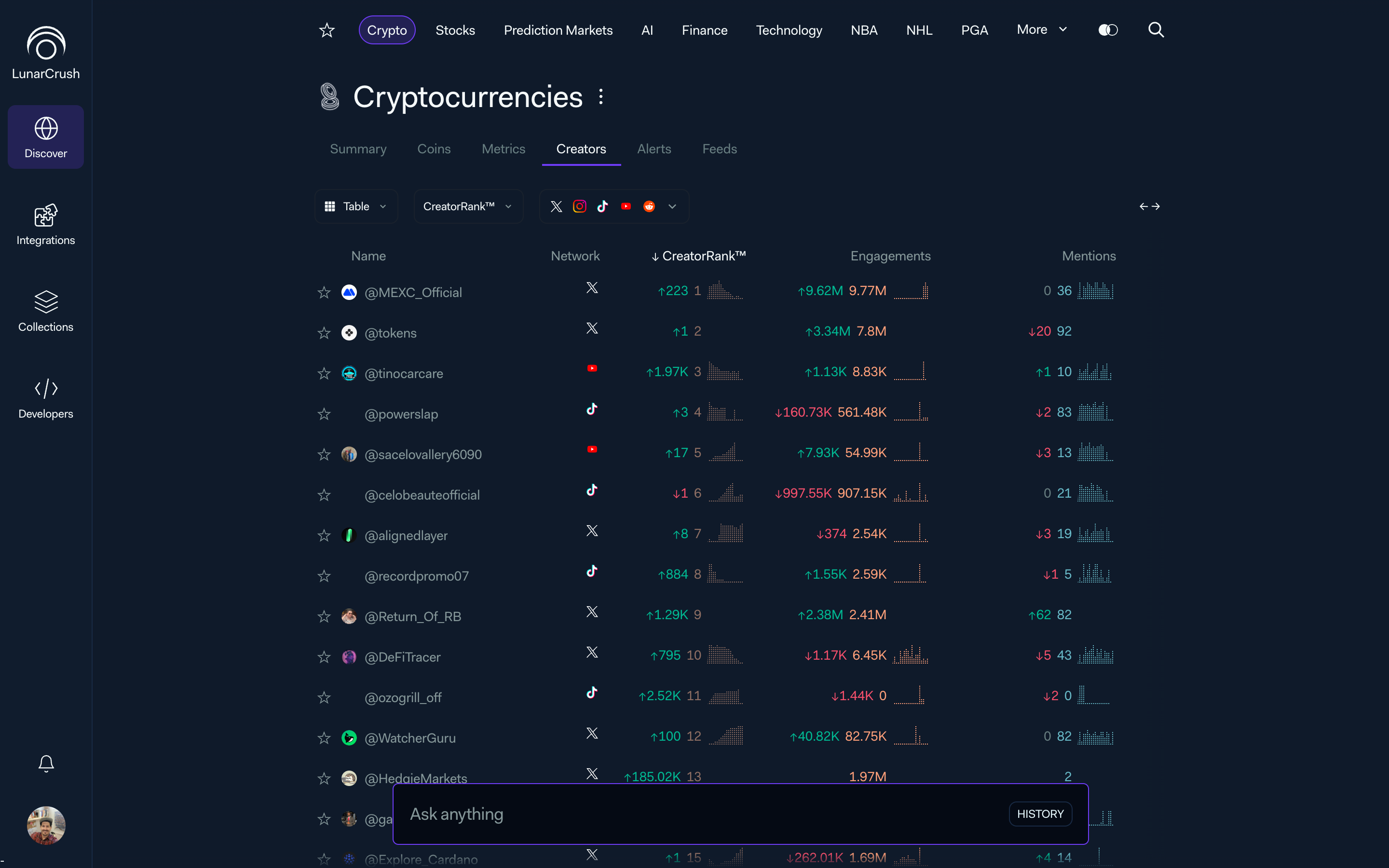
Alerts and Feeds close the set: configurable triggers and the raw stream filtered to the category.
Not just crypto
Crypto is the easy demo. The product is built for anything social data can measure.
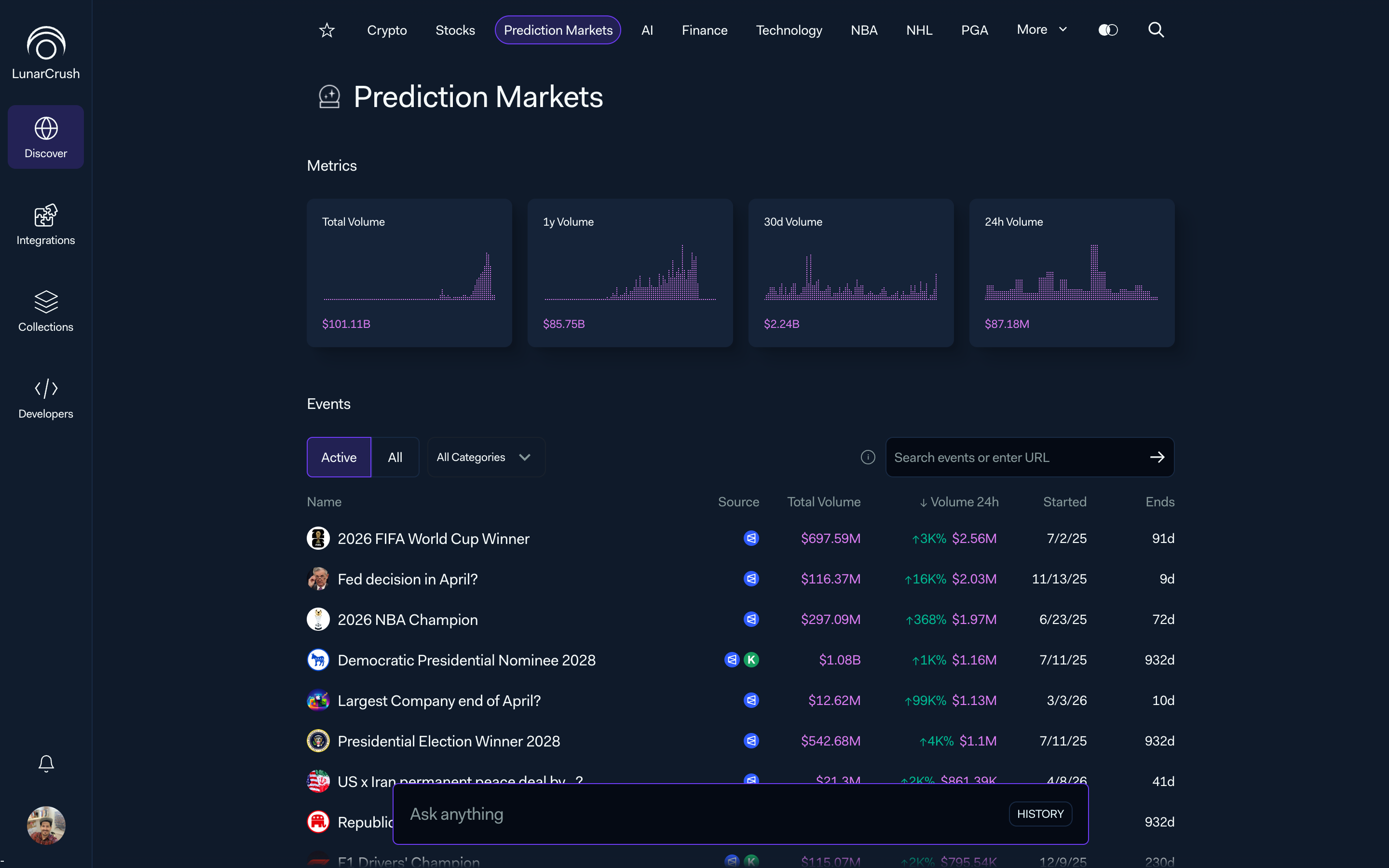
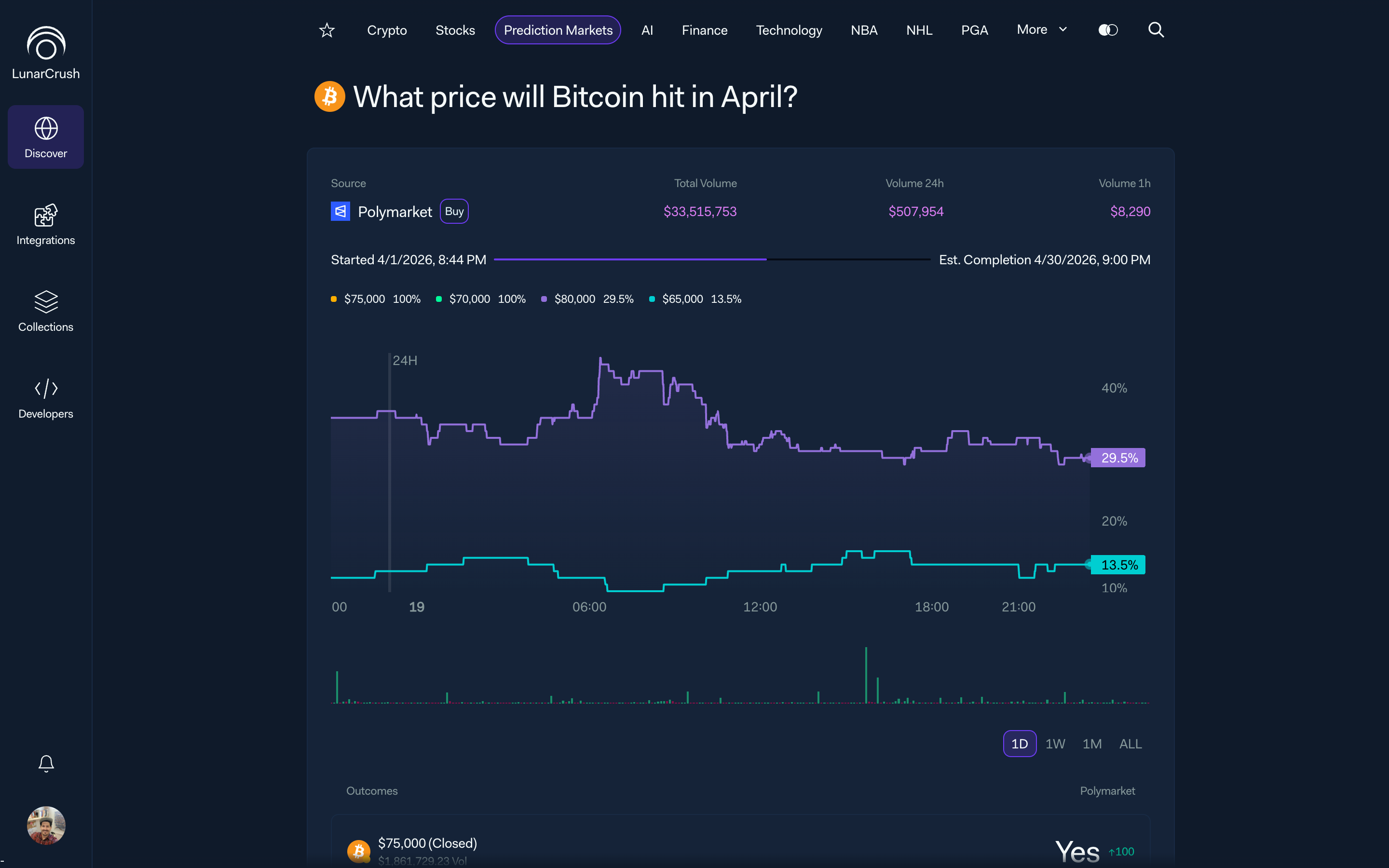
Prediction Markets becomes a category whose children are prediction events, each with its own odds, volume, and social activity. A single prediction ("What price will Bitcoin hit in April 2026?") gets its own detail page with the same topic shell.
Sports verticals swap "Coins" for "Teams". The table columns change (Engagements, Social Dominance) but the shell is the same.
Stocks use price-based leading columns; AI, Finance, Technology do the same with their own native lenses.
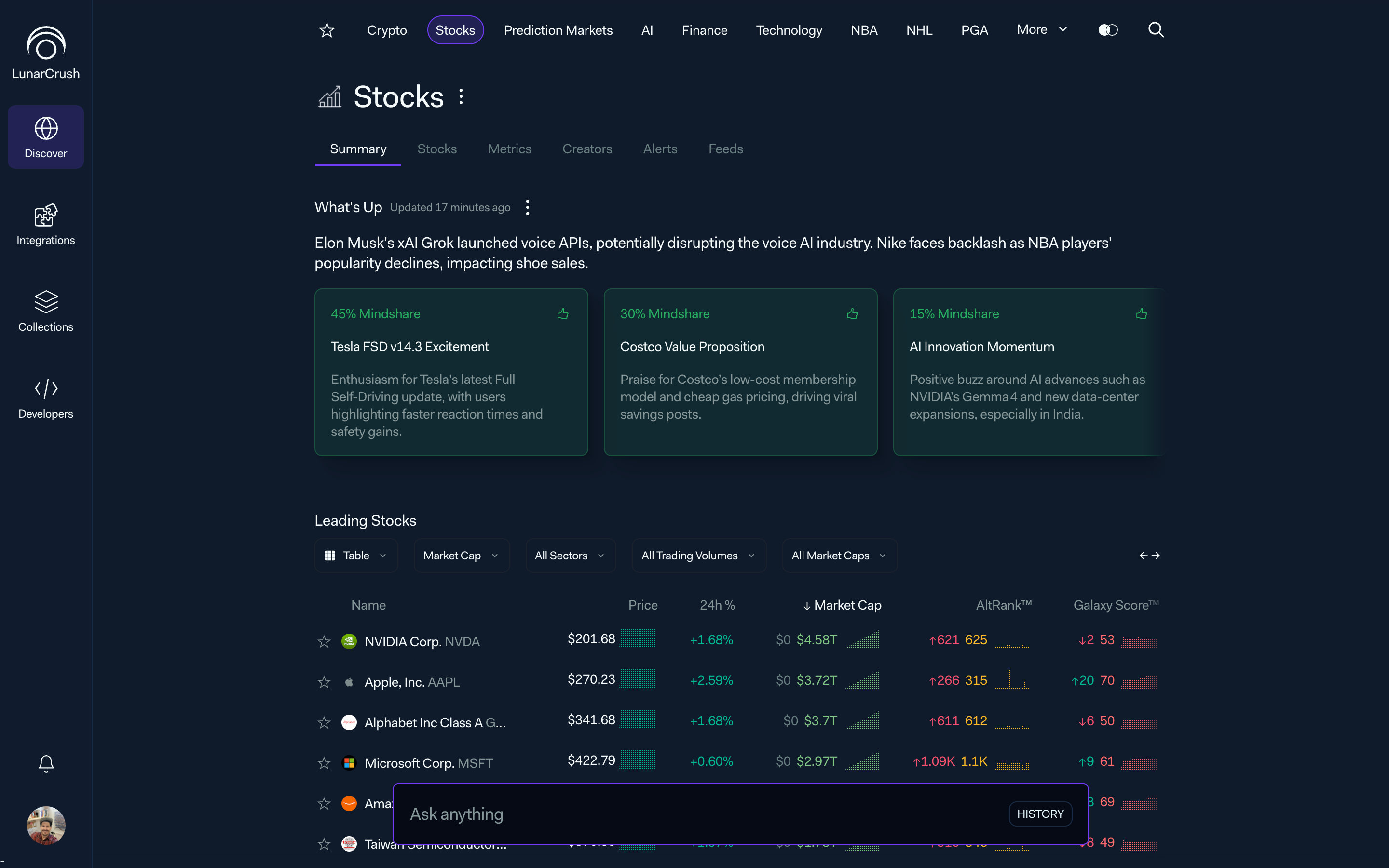
One product, many domains. The top pill nav (Crypto / Stocks / Prediction Markets / AI / Finance / Technology / NBA / NHL / PGA / More) is the category switcher.
Creators as first-class topics
People are topics too. A creator page behaves like any other: header adapts to the creator type (platform handle, follower count, CreatorRank), then the familiar tab structure.
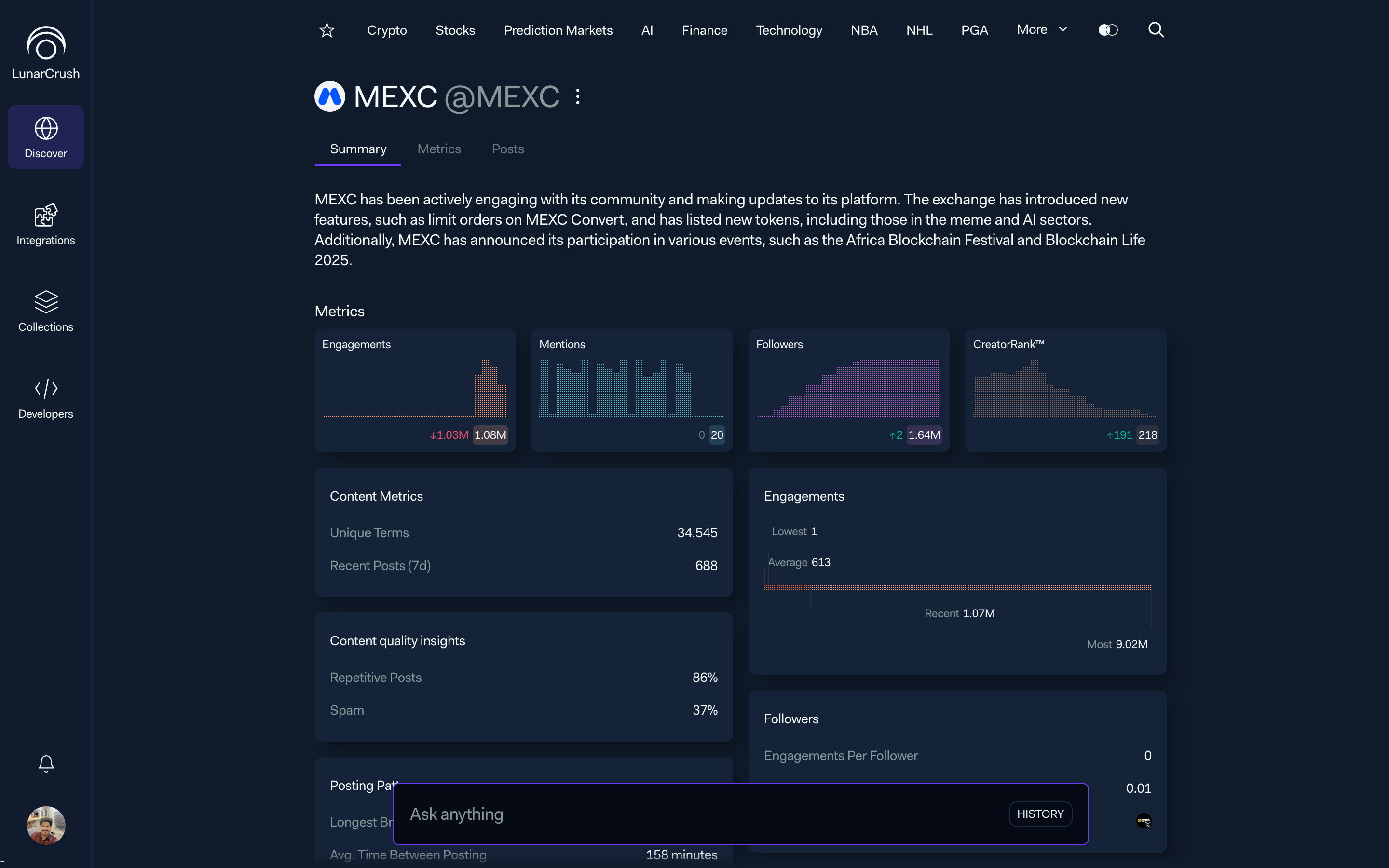
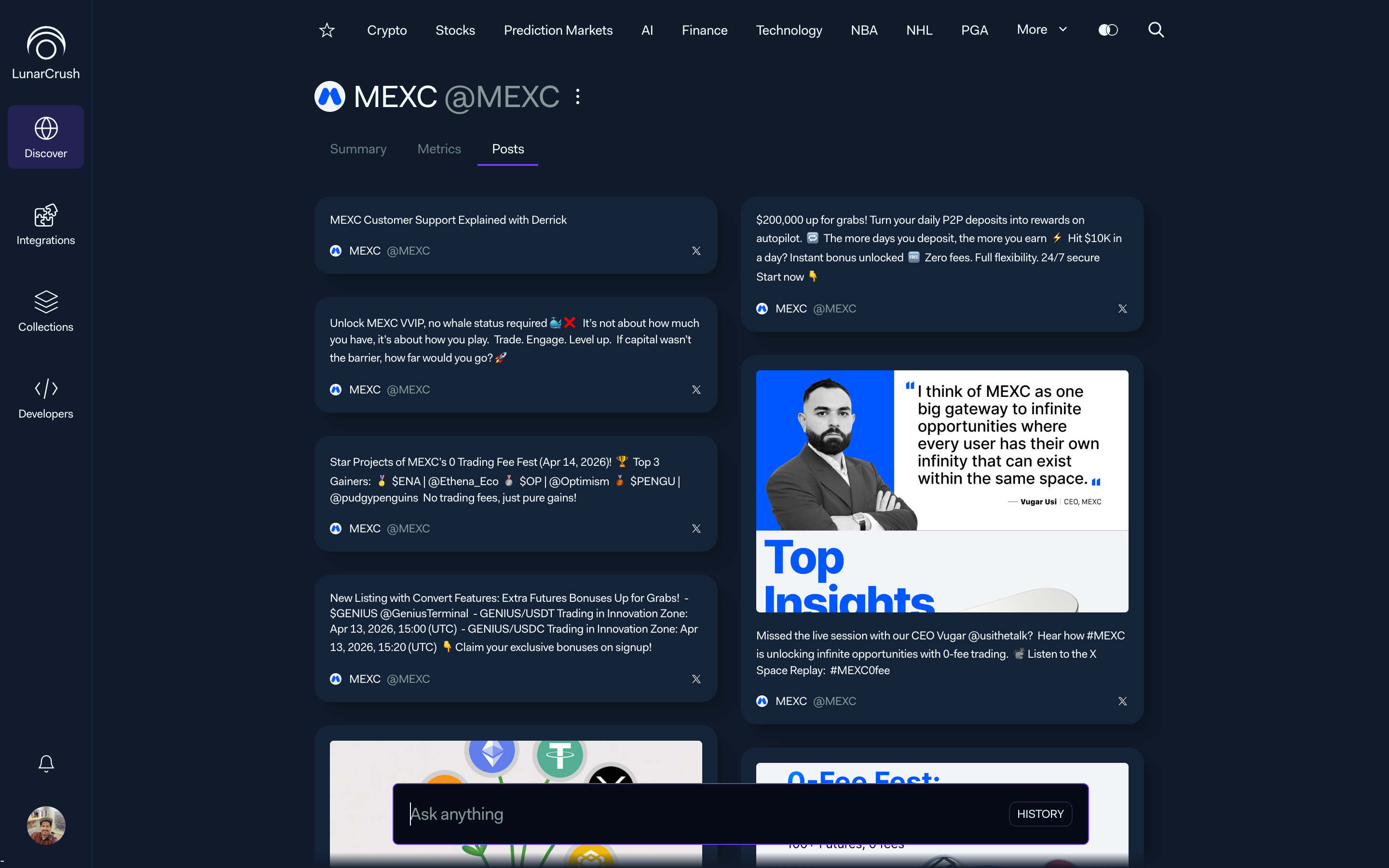
Summary, Metrics, and Posts: same pattern as an asset, only the leading columns change. Posts drops to the raw stream of what this creator is publishing.
Collections
Collections let a user build their own topic, a named bundle of search terms that LunarCrush aggregates like any native topic. Each collection gets a slug and is available across the UI and the API. Teams use this to spin up custom benchmarks, narratives, or portfolios without waiting on us to add them natively.
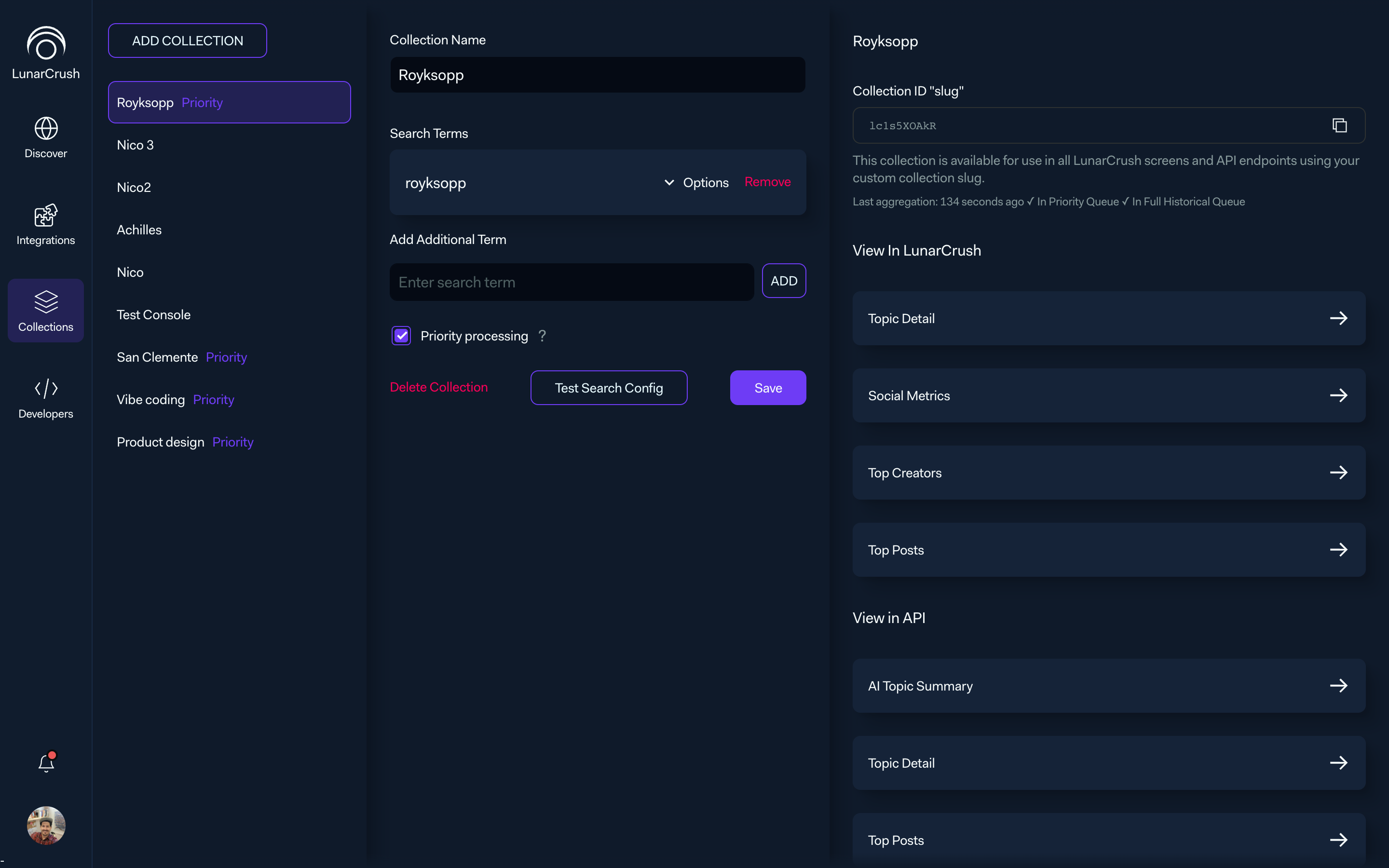
A Priority processing toggle tells the pipeline to aggregate this collection more frequently. Every collection surfaces its own Topic Detail, Social Metrics, Top Creators, and Top Posts inside LunarCrush, plus an AI Topic Summary endpoint the user can call externally.
Integrations: the bridge to the next product
This is the surface that matters most for where LunarCrush is going next.
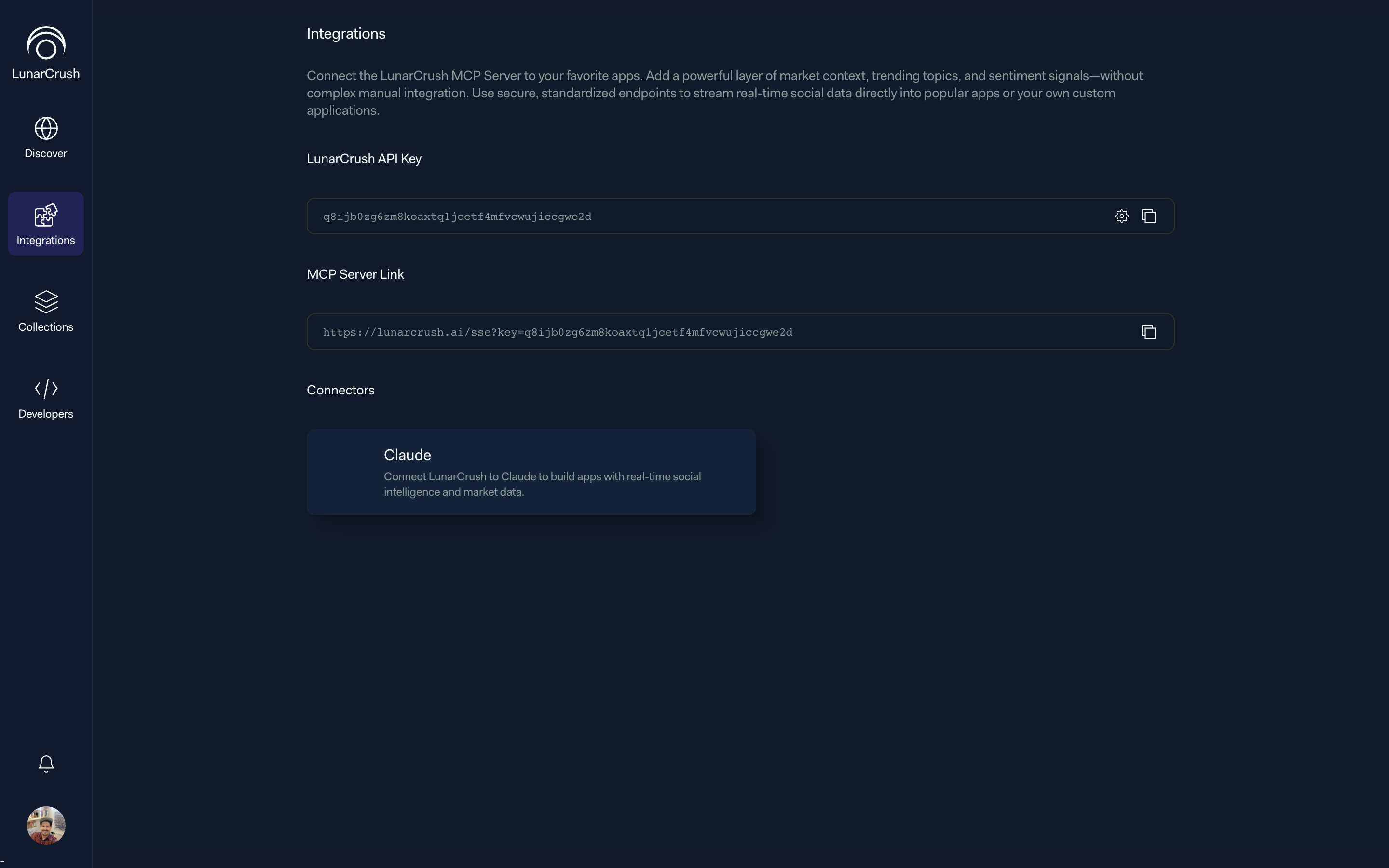
Integrations exposes the user's API key, their personal MCP Server Link (lunarcrush.ai/sse?key=…), and a growing list of connectors. Right now Claude, with many more models on the roadmap.
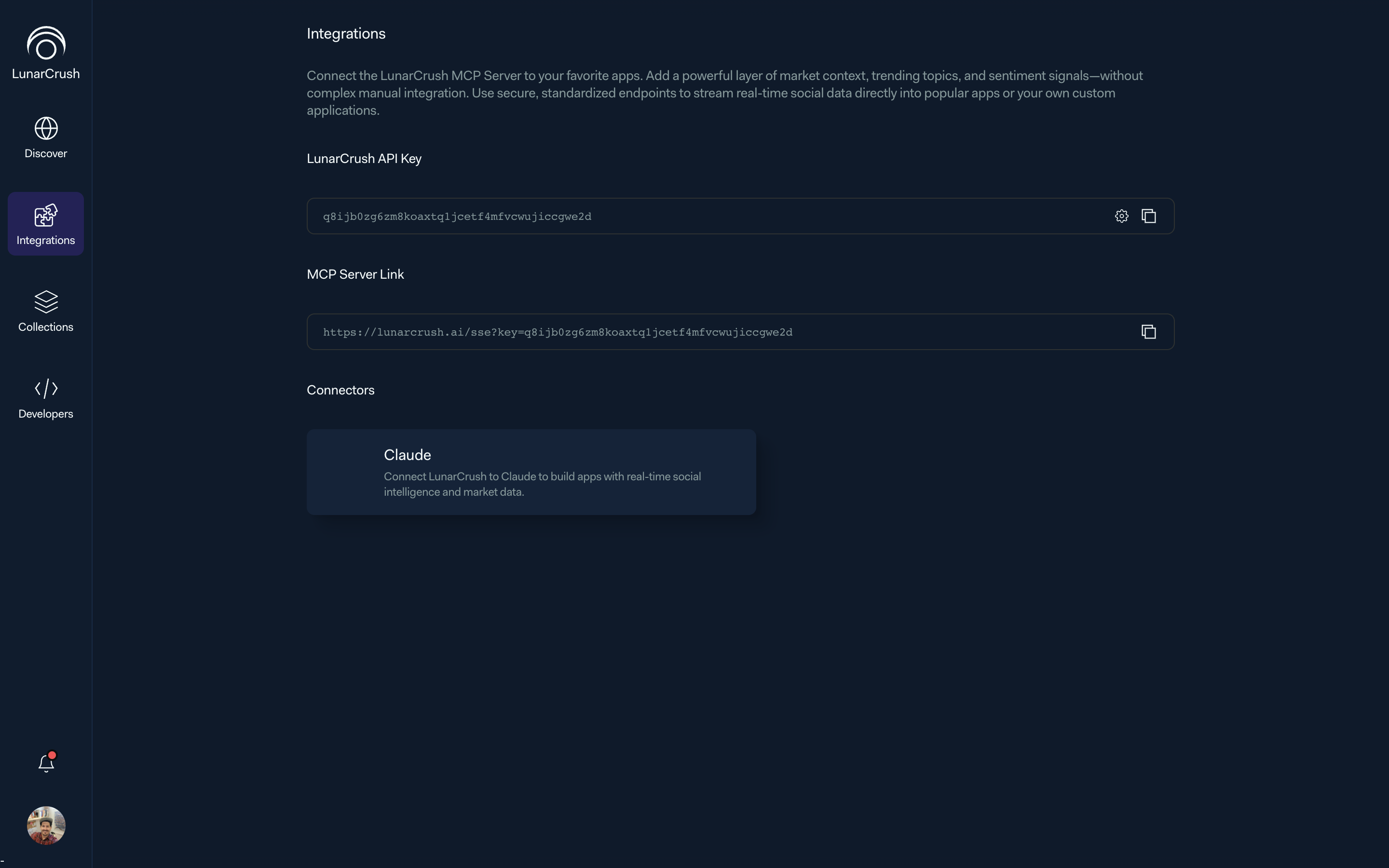
The thesis: the LunarCrush app is one of many surfaces LunarCrush data will live in. Power users already run our MCP inside their own Claude, Cursor, ChatGPT setups. Integrations is where they light that up with one click, and it's the launchpad for the next product we're building, a LunarCrush that travels with the user into whatever LLM they prefer, not only the one we chose to embed.
Everything earlier in this case study (the topic spine, the category tabs, the creator pages, the collections) becomes the vocabulary the MCP speaks back out into those external models. The in-app AI and the out-of-app AI are the same AI.
Developers
For teams building directly on LunarCrush data, Developers is the dedicated surface: API overview, keys, usage, docs, endpoint reference.
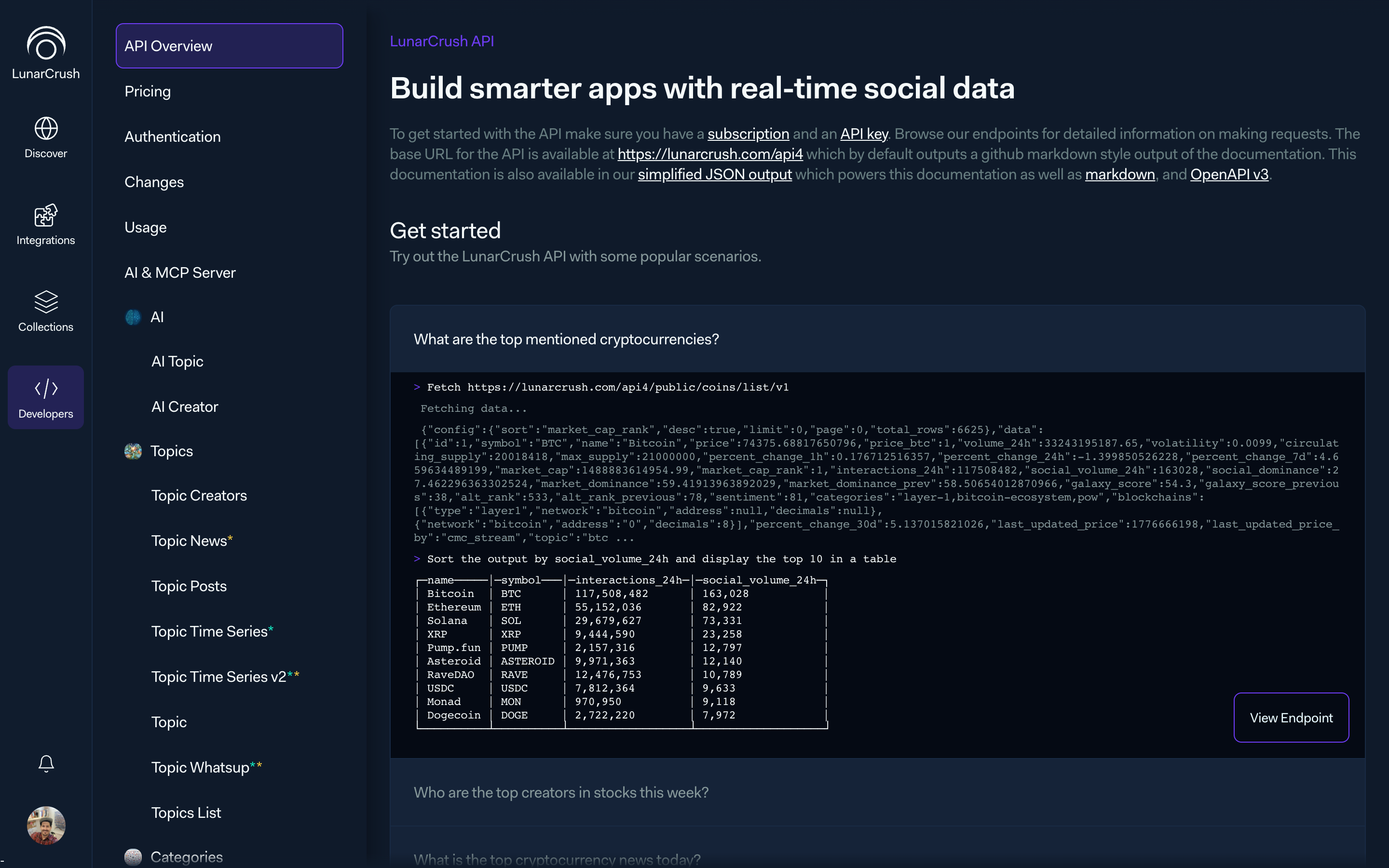
Same data the product and the MCP use. One pipeline, three doorways: UI, MCP, API.
Personalization & account
Once signed in, the app remembers: last category, last metric, pinned favourites, prompt history, connected identities, and a running "relevant topics" map derived from what you've searched and revisited. Signed-in topic pages surface identity badges and account-linked actions.
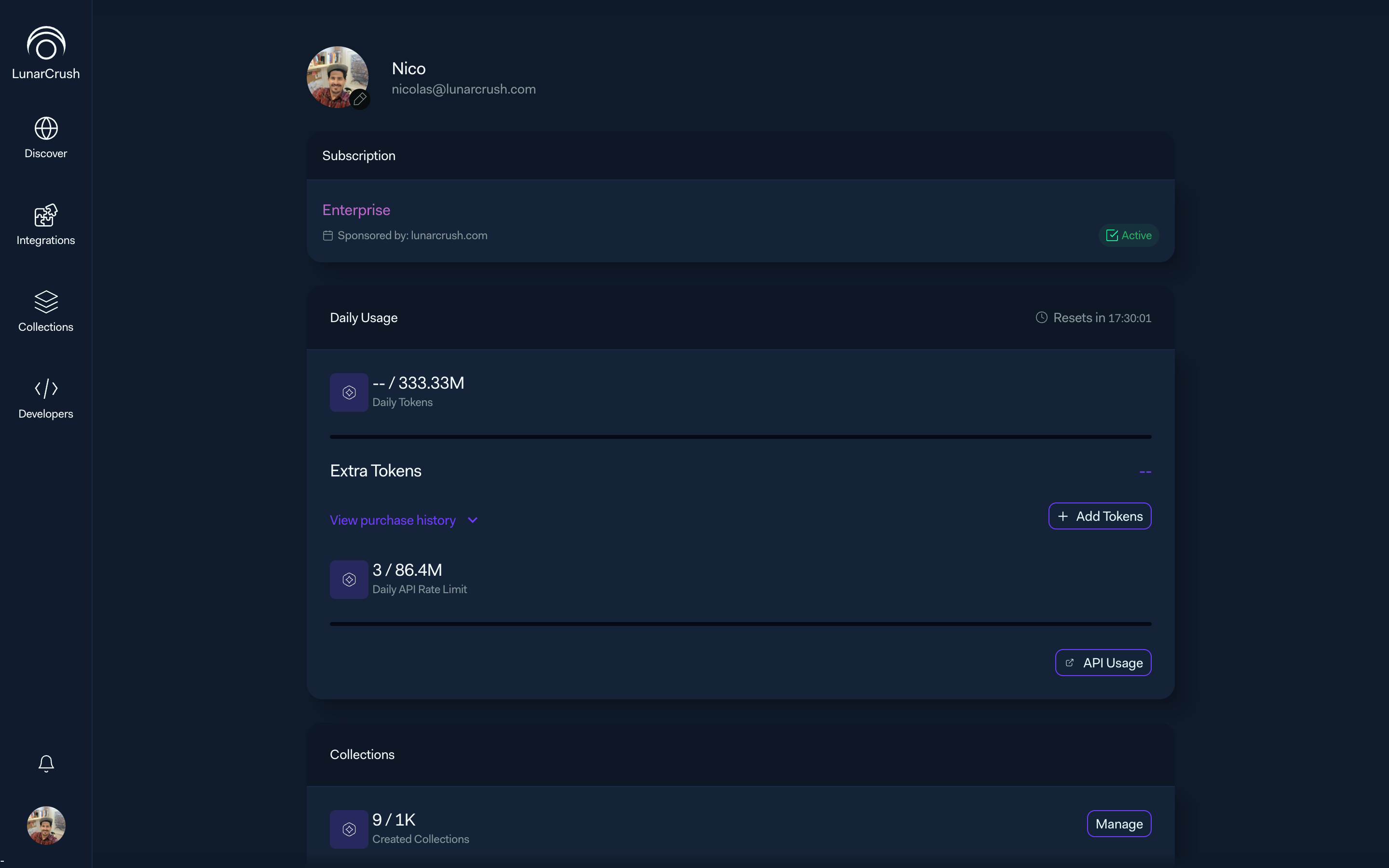
Account handles billing, API usage, linked social identities (Coinbase, X, YouTube, TikTok…), theme, currency, privacy, and the escape hatch to the legacy app.
What still lives in the old app
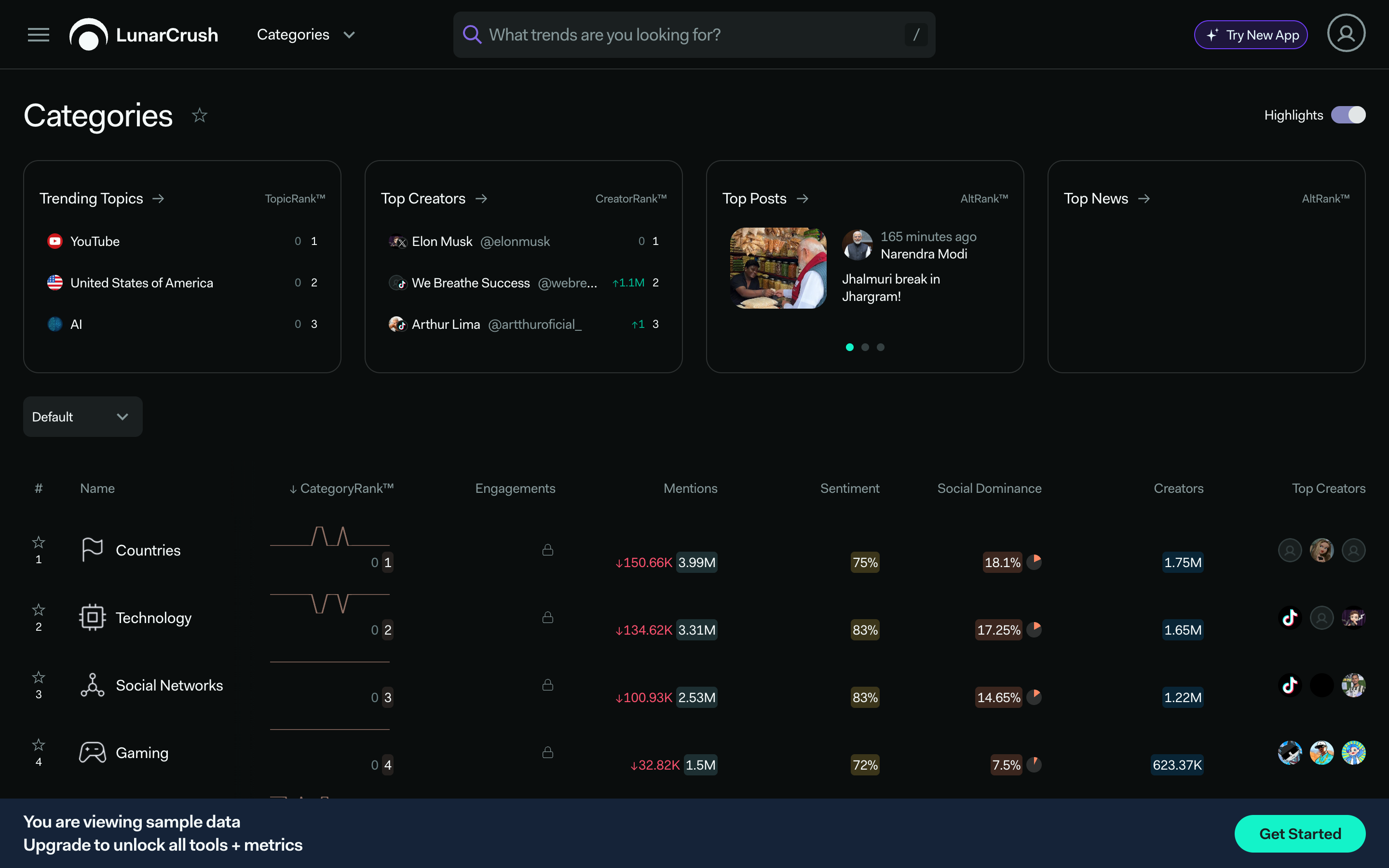
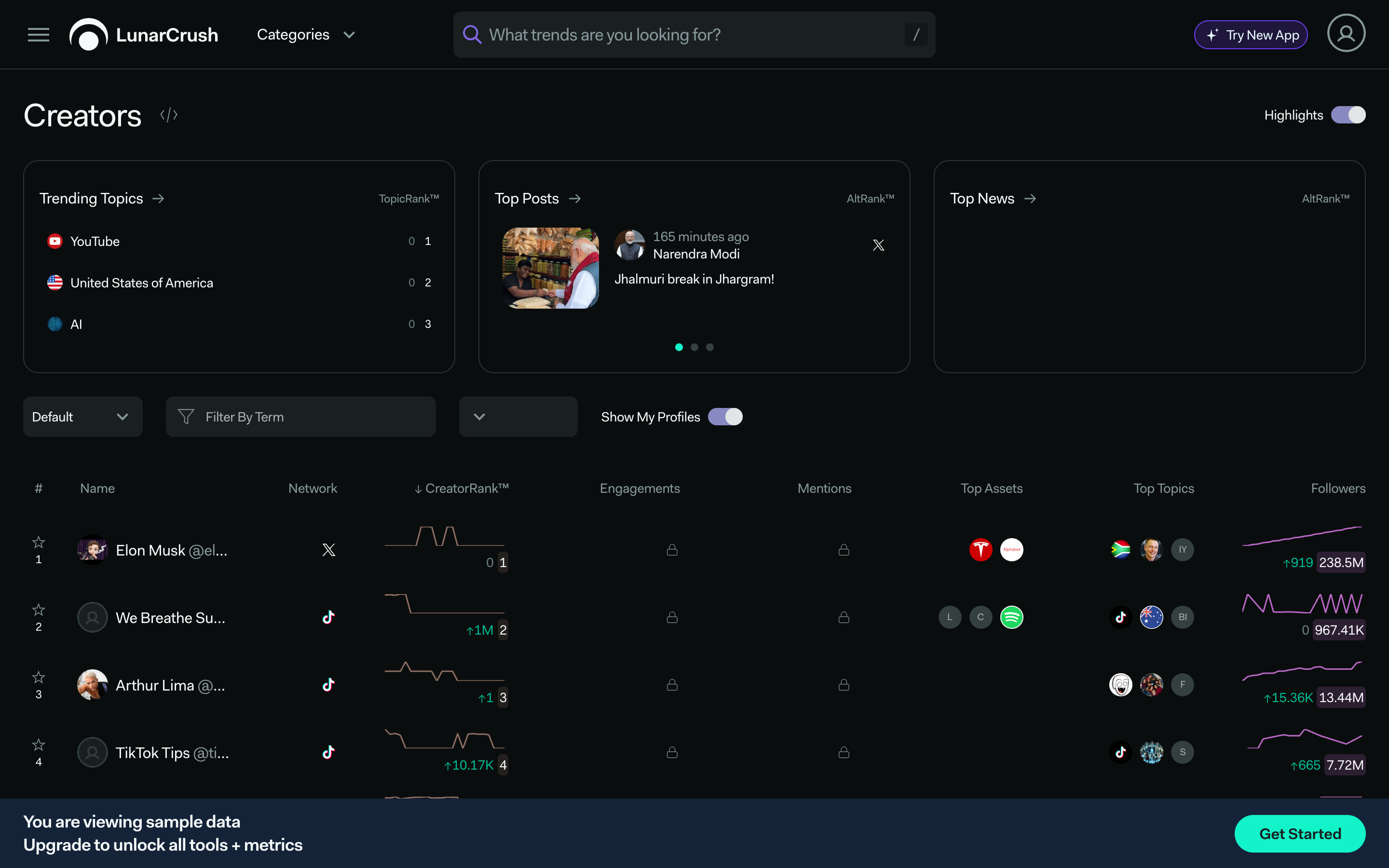
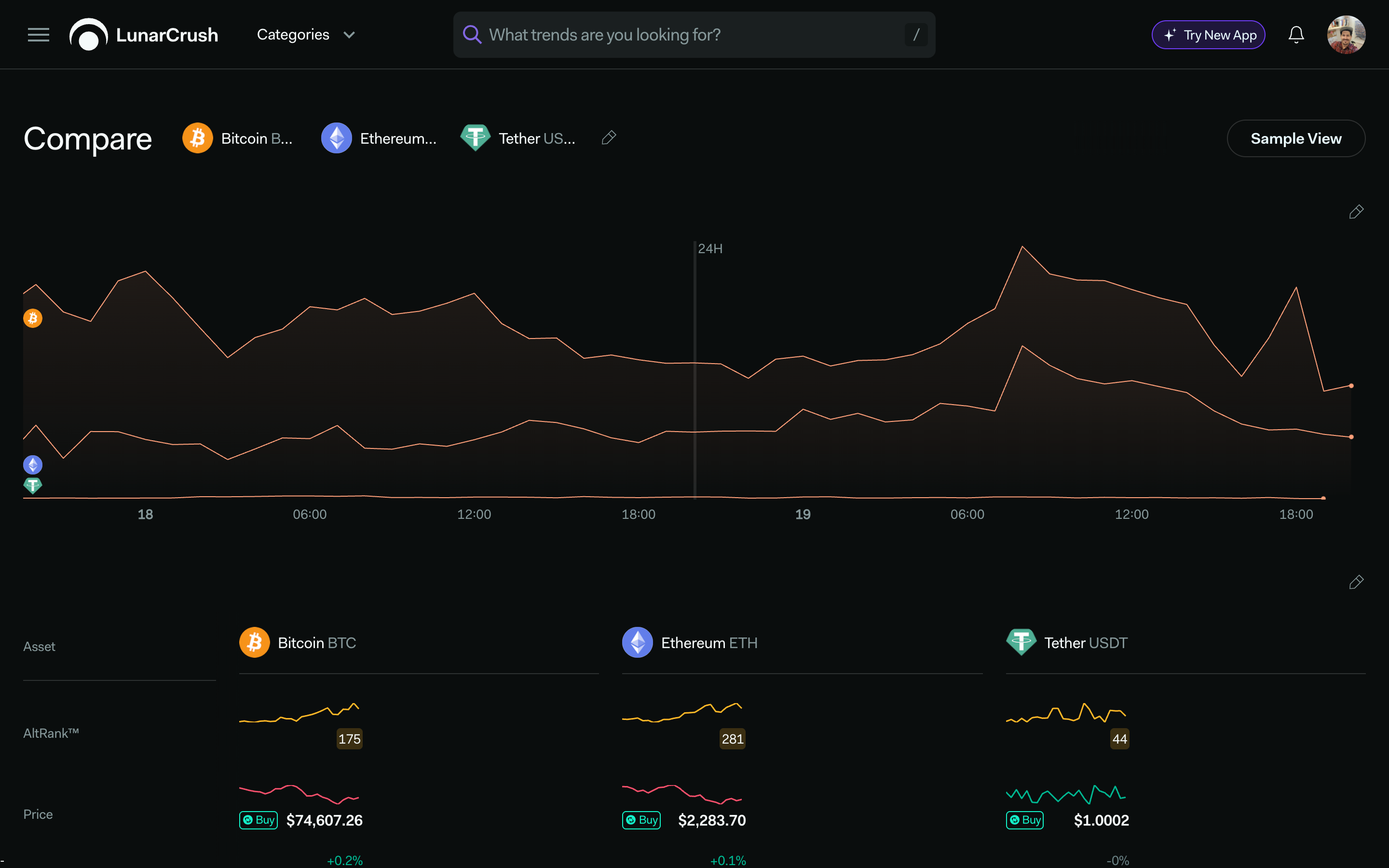
A few surfaces didn't make the jump: Compare (side-by-side topic analysis), the full Categories directory, and the old Creators index. Reachable from Account → "View old LunarCrush Website".
We deprioritised migrating them on purpose. Each one is either a power-user tool or a directory, and both classes work better as a next step inside a conversation than as a destination. An AI-authored answer can generate a side-by-side comparison inline; a creator lookup becomes "show me the top BTC influencers this week", not a click through a ranked list. They'll come back in the new shell when the AI-first framing tells us how they should feel.
Process & scope
My role was less "ship UI" than "figure out what LunarCrush becomes when every user arrives with a model already loaded." That looked like:
- Running recurring working sessions with engineering, data, and leadership to test how our metrics read when rendered inside a conversation: which charts survive, which explanations the model has to carry, where the hand-off from component to prose happens.
- Defending the 700-pixel column across multiple sprints when pressure to go wide came up.
- Designing the conversation → component loop: what the LLM renders with, where it reaches for data, how we keep the visual language coherent between a static page and an AI-generated one.
- Picking one primitive, the topic, and pushing every surface (categories, creators, collections, integrations, developers) through it.
- Making the call on which old-app surfaces to leave behind, and when they come back.
Role: Head of Design, LunarCrush. January 2021 to present.
Related work: The Rebuild · Design Rationale · Compare · Landing Pages · Trading Bot.
Live product: lunarcrush.com.
Latest updates
- A premium brand for LunarCrush: Turning a flat mark into a premium brand proposal: one material, a petrol color nobody in crypto owns, a human layer, a landing built as a media exercise, a live preview with an enterprise funds page, a written brand sys
- NFL and Fantasy Football on LunarCrush: In three weeks LunarCrush went from a crypto-first product to one with a full NFL category and a Fantasy Football app: an ESPN and Sleeper pipeline into D1, one page per team and player, and a signal that compares sharp
- Rebuilding LunarCrush: The 2026 redesign in progress: how we are rebuilding the product around AI-first behavior, what the data told us before we started, and the working sessions with Jon Farjo, our CPO, that have been shaping every decision
- LunarCrush 2026 — Rebuilding Compare: Compare used to be a three-asset, 24-hour, price-first page in the old app. In the 2026 workspace it became something else: unlimited topics across any category, adaptive metrics, and the contextual layer around the comp
- LunarCrush 2026: The Design Underneath: A companion to the main product case study. The decisions behind the 700-pixel column, the topic-as-primitive architecture, and the system of components that lets the AI speak in the app's native voice.
- LunarCrush.com Landing Pages: Complete redesign and production build of 17 landing pages, from design direction to deployed code on Cloudflare Pages.